One picture can speak a thousand words, which seems to be true when it comes to hazard identification and communication. Pictures, or rather hazard pictograms, which are used for the labelling of chemicals, are meant to convey a clear message about potential dangers and hazards of the labelled chemical product across the language barriers and help the user stay safe while handling the chemical by informing them about the risks and risk preventive measures.
What are the hazard pictograms, and why do we use them?
Hazard pictograms are used to alert the presence of a hazardous chemical. The pictograms should help us know which chemicals we are using might be dangerous and can cause harm to people or the environment. Globally Harmonized System (GHS) for classifying and labelling chemicals prescribes nine different pictograms. The GHS hazard pictograms appear in the shape of a diamond with a distinctive red border and white background. Due to the GHS regulation implementation around the globe, these are now considered almost universal and applicable in most markets and countries worldwide.
The pictograms are used to describe specific hazards associated with the chemicals. It is not unusual to have more than one pictogram appearing on the labelling of a single chemical. The table below shows all GHS hazard pictograms with a short description and the associated hazards.
Table 1. GHS hazard pictograms
Pictogram symbol | Pictogram code | Associated hazards | General explanation |
|---|---|---|---|
 | GHS01 Explosive (Symbol: exploding bomb) |
| Chemicals that can cause explosions. |
 | GHS02 Flammable (Symbol: flame) |
| Chemicals that can burn or can release gases that burn. |
 | GHS03 Oxidising (Symbol: flame over circle) |
| Chemicals that give off oxygen and can make a fire spread. |
 | GHS04 Gas under pressure (Symbol: gas cylinder) |
| Gases or liquids which are under pressure and for that reason can explode. |
 | GHS05 Corrosive (Symbol: corrosion) |
| Chemicals that cause permanent damage to skin or eyes are corrosive to metals. |
 | GHS06 Acute toxicity (Symbol: skull and crossbones) |
| Poisonous chemicals can quickly cause severe sickness or even death. These toxins attack one or more body parts/organs. Considered toxic or fatal. |
 | GHS07 Health hazard/ Hazardous to the ozone layer (Symbol: exclamation mark) |
| Chemicals which can cause health issues, which usually do not lead to severe illnesses or death. Pictograms might also be used for chemicals that destroy the ozone layer. |
 | GHS08 Serious health hazard (Symbol: health hazard) |
| Chemicals can cause serious health issues or illnesses. Effects can be immediate or delayed. |
 | GHS09 Hazardous to the environment (Symbol: environment) |
| Chemicals dangerous for the environment. These chemicals should not enter waterways or soil. |
The GHS hazard pictograms are primarily used for the labelling of the containers for the consumers and at the workplace. While they can be used in transport, the second set of pictograms is usually used to transport dangerous goods. Transport pictograms are used in a wider variety of colours and may contain additional information such as a subcategory number.
Table 2. Transport of the dangerous goods hazard pictograms
Pictogram | Class | Associated hazards |
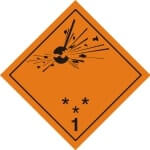 | 1 - Explosives | Division 1.1 - Substances and articles which have a mass explosion hazard Division 1.2 - Substances and articles which have a projection hazard but not a mass explosion hazard Division 1.3 - Substances and articles which have a fire hazard and either a minor blast hazard or a minor projection hazard or both, but not a mass explosion hazard Note: The asterisks are replaced by the class number and compatibility code |
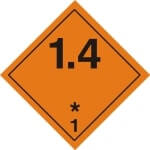 | 1 - Explosives | Division 1.4 - Substances and articles which are classified as explosives but which present no significant hazard Note: The asterisk is replaced by the compatibility code |
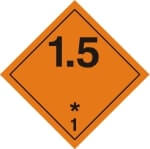 | 1 - Explosives | Division 1.5 - Very insensitive substances which have a mass explosion hazard Note: The compatibility code replaces the asterisk |
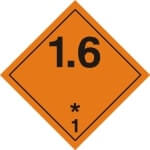 | 1 - Explosives | Division 1.6 – No hazard statement Note: The compatibility code replaces the asterisk |
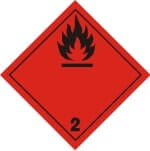 | 2 - Gases | Division 2.1: Flammable gases – Gases which at 20 °C and a standard pressure of 101.3 kPa:
(alternative pictogram) |
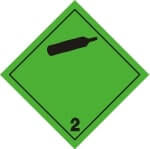 | 2 - Gases | Division 2.2: Non-flammable, non-toxic gases – Gases which:
 (alternative pictogram) |
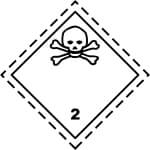 | 2 - Gases | Division 2.3: Toxic gases – Gases which:
|
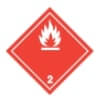
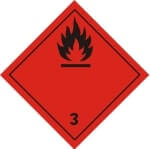 | 3 – Flammable liquids | Flammable liquids – Liquids that have a flashpoint of less than 60 °C and which are capable of sustaining combustion  (alternative pictogram) |
 | 4 – Flammable solids | Division 4.1: Flammable solids, self-reactive substances and solid desensitised explosives – Solids which, under conditions encountered in transport, are readily combustible or may cause or contribute to fire through friction; self-reactive substances which are liable to undergo a strongly exothermic reaction; solid desensitised explosives which may explode if not diluted sufficiently |
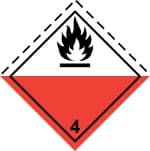 | 4 – Flammable solids | Division 4.2: Substances liable to spontaneous combustion – Substances which are liable to spontaneous heating under normal conditions encountered in transport, or to heating up in contact with air, and being then liable to catch fire |
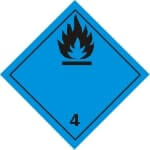 | 4 – Flammable solids | Division 4.3: Substances in contact with water emit flammable gases – Substances which, by interaction with water, are liable to become spontaneously flammable or to give off flammable gases in dangerous quantities
(alternative pictogram) |
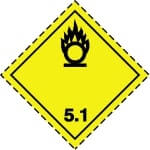 | 5 -Oxidizing substances | Division 5.1: Oxidizing substances – Substances which, while in themselves not necessarily combustible, may, generally by yielding oxygen, cause, or contribute to the combustion of other material |
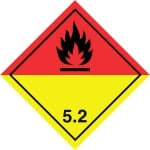 | 5 -Oxidizing substances | Division 5.2: Organic peroxides – Organic substances which are considered derivatives of hydrogen peroxide, where one or both of the hydrogen atoms have been replaced by organic radicals
(alternative pictogram) |
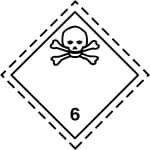 | 6 – Toxic substances | Division 6.1: Toxic substances – substances liable either to cause death, serious injury or to harm human health if swallowed, inhaled or by skin contact; |
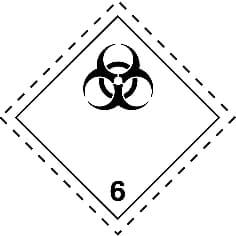 | 6 - Infectious substances | Division 6.2: Infectious substances - substances known or reasonably expected to contain pathogens. Pathogens are defined as microorganisms (including bacteria, viruses, rickettsiae, parasites, fungi) and other agents such as prions can cause disease in humans or animals. Note: Class and pictogram included in the UN Model Regulations but have not been incorporated into the GHS |
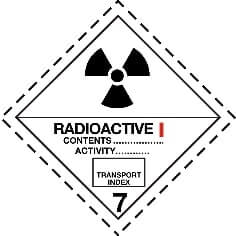 | 7 - Radioactive material | Radioactive material means any material containing radionuclides where both the activity concentration and the total activity in the consignment exceed the values specified in the regulation – LSA I (low specific activity 1) Note: Class and pictogram included in the UN Model Regulations but have not been incorporated into the GHS |
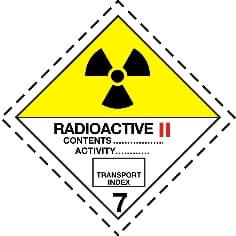 | 7 - Radioactive material | Radioactive material means any material containing radionuclides where both the activity concentration and the total activity in the consignment exceed the values specified in the regulation – LSA II (low specific activity 2) Note: Class and pictogram included in the UN Model Regulations but have not been incorporated into the GHS |
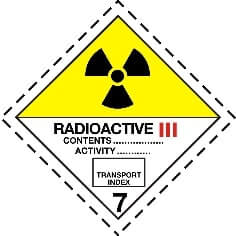 | 7 - Radioactive material | Radioactive material means any material containing radionuclides where both the activity concentration and the total activity in the consignment exceed the values specified in the regulation – LSA III (low specific activity 3) Note: Class and pictogram included in the UN Model Regulations but have not been incorporated into the GHS |
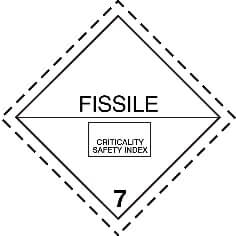 | 7 - Radioactive material | Fissile material means uranium-233, uranium-235, plutonium-239, plutonium-241, or any combination of these radionuclides. Note: Class and pictogram included in the UN Model Regulations but have not been incorporated into the GHS |
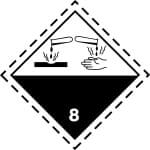 | 8 – Corrosive substances | Corrosive substances – Substances which:
|
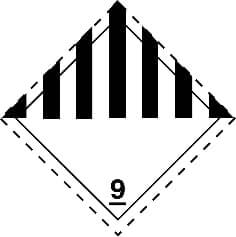 | 9 - Miscellaneous dangerous substances and articles | Miscellaneous dangerous substances and articles - are substances and articles that present a danger not covered by other classes during transport. Includes:
Note: Class and pictogram included in the UN Model Regulations but have not been incorporated into the GHS GMMOs or GMOs are not subject to these Regulations when authorised for use by the competent authorities of the Governments of the countries of origin, transit and destination. |


Other chemical safety symbols
Besides the hazard pictograms, other chemical safety signs and symbols are commonly used in the HSE world. These can be divided into four standardised categories –
- prohibition,
- warning,
- mandatory, and
- emergency.
Each category can be recognised by its colour and shape (see table 3). The purpose of these symbols is to instruct the workers to stop the operation, take precautions, move or select the proper personal protective equipment. The following table shows the four categories associated with colours, features, associated instructions, and examples.
Table 3. Other chemical safety signs and symbols
Category | Colour and features | Associated instructions | Pictogram example |
Prohibition | Red circle crossed out frame with black symbol and white background | ‘’do not’’; Stop the operation; Evacuate; Prohibited access; |
No open flame |
Warning | Yellow triangular shape with black frame and black symbol and yellow background | Take precautions |
Electricity hazard |
Mandatory | Blue round shape with white symbol and blue background | Use this Complete the action |
Wear protective gloves |
Emergency | Green or red rectangle or square shape with white symbol and green/red background | First aid or emergency measures |
Eye wash station
Fire extinguisher |
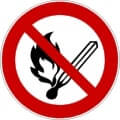
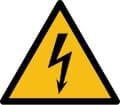


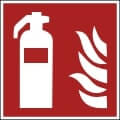
A single area usually contains more than one sign. Production hall will, for example, have multiple pictograms showing the mandatory personal protective equipment that needs to be used at the workplace and signs on where the first aid kit is located, or fire extinguisher or emergency alarm button can be found. Prohibition signs could also be found, labelling the area where it is restricted or prohibited to eat and drink or smoke. Warning symbols could also be attached for high voltage machinery or a possibility for slipping hazards. All of these can be located in one area or facility if needed.
These symbols are usually used on workplace instructions (WPI) or safety sheets. WPI’s or safety sheets are one- or two-page documents prepared by the HSE personnel to inform the workers about the risks and safety measures associated with using hazardous products. Some countries have implemented the WPI preparation and use at the workplace. WPI’s usually contain information derived from the SDS’ and exposure scenarios but modified to suit the local handling needs. These simplified documents typically contain the following information:
-
Chemical identification and hazard information
-
First aid and safety measures
-
Emergency measures in case of fire
-
Accidental release measures and information about disposal
-
Local information (e.g. local emergency numbers, responsible persons info, department information)
If your country has not implemented WPI requirements in their chemical legislation framework, they are probably not prohibiting their use either. This is why, in a joint project, the World Health Organisation (WHO), International Labour Organisation (ILO) and European Commission (EC) have joined hands and formed a collection of over 1700 documents identifying chemical hazards and called them International Chemical Safety Cards (ICSC’s). The ICSC’s are available in the database in 12 different languages: English, French, Spanish, Russian, Chinese, Italian, Japanese, Finnish, Hungarian, Polish, Hebrew, Korean and Persian. All of the documents are being reviewed every two years.
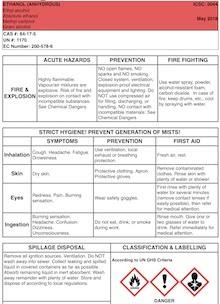
An example of an International Chemical Safety Card. Source: International Labour Organization.
The information available in the ICSC includes:
-
Identification of the chemical
-
First aid
-
Fire and explosion hazards
-
Preventative measures
-
Classification and labelling
-
Firefighting measures
-
Physical and chemical properties and dangers
-
Environmental data
-
Long- and short-term health effects
-
Storage, packaging and spillage disposal
-
Acute health hazards and prevention
-
Regulatory information and occupational exposure limits.
ICSC provides enough information at a glance for a worker who is not familiar with the technicality of the SDS’ to access and use safety information necessary for safe handling of the chemical. Similarly to WPI’s, ICSC documents are also prepared based on the information available in the SDS’. Being the simplified version of the SDS’, ICSC’s are usually used to transpose the SDS information for direct use at the workplace. ICSC’s can’t be used as a substitute for the SDS’ as they do not entirely follow the regulatory requirements according to the SDS’ are prepared.
Even though hazard pictograms and safety symbols, and cards are internationally used, there may still be some local differences that need to be considered. Please be always advised to check and follow local requirements to stay compliant at the workplace.