












Incident management software

The near miss is where incident management starts

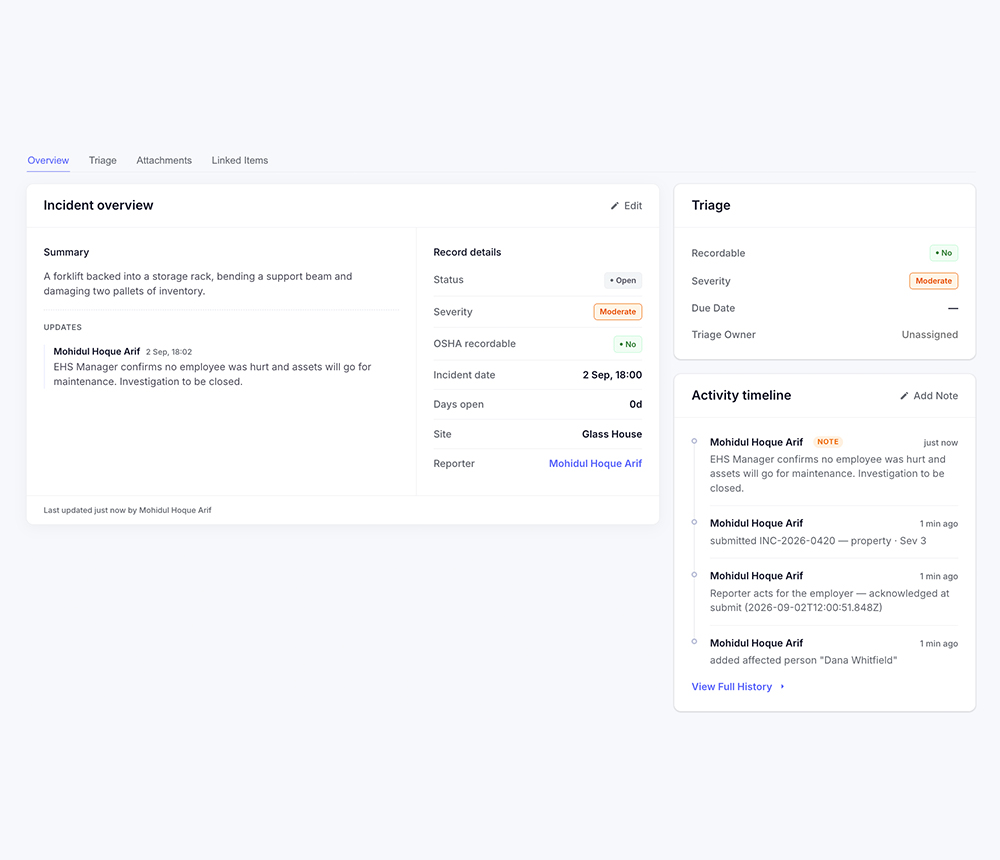
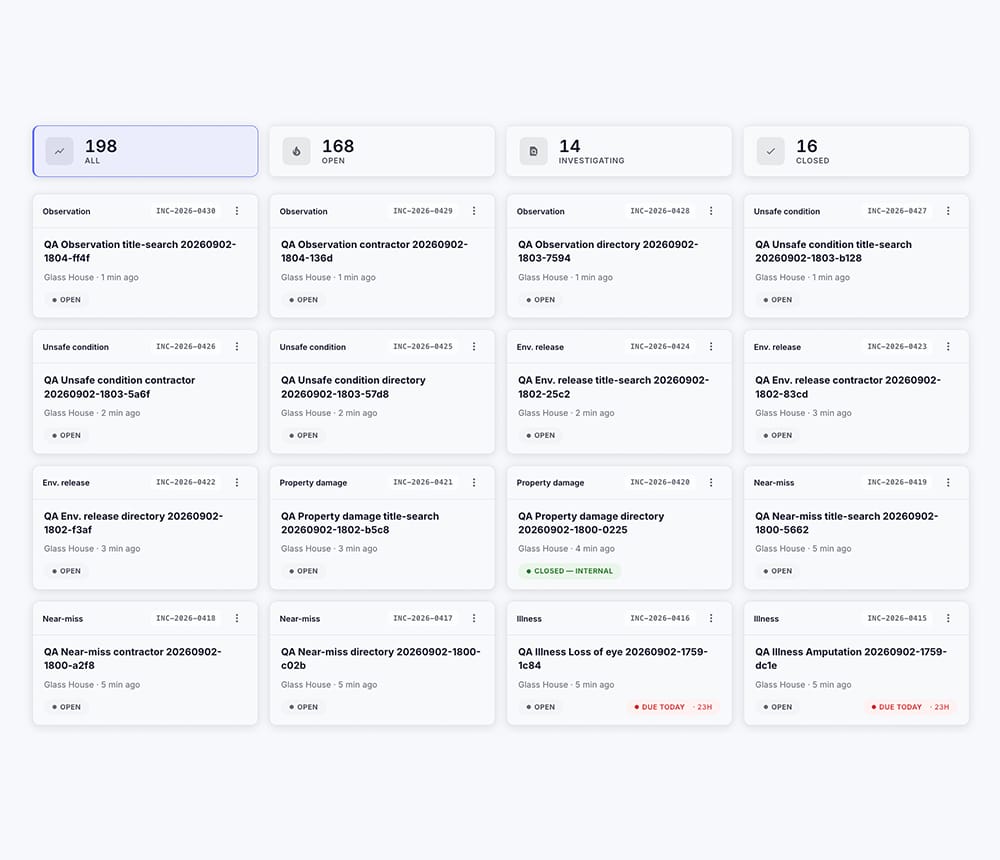
Incident management software where reporting takes thirty seconds, so people report the near misses too. You fix things before they hurt anyone, and the record is already complete when an inspector asks.

A supervisor recording an incident on a tablet on the shop floor
Trusted by10,000+ Safety Managers

The near misses you never hear about are the ones that matter

Near miss reporting is free information, and it only reaches you if reporting is easier than not reporting. That means no login, no desktop, and no form asking a supervisor to grade severity at six in the morning.

Also called
Incident reporting software, accident reporting software, near miss reporting software
Ways in
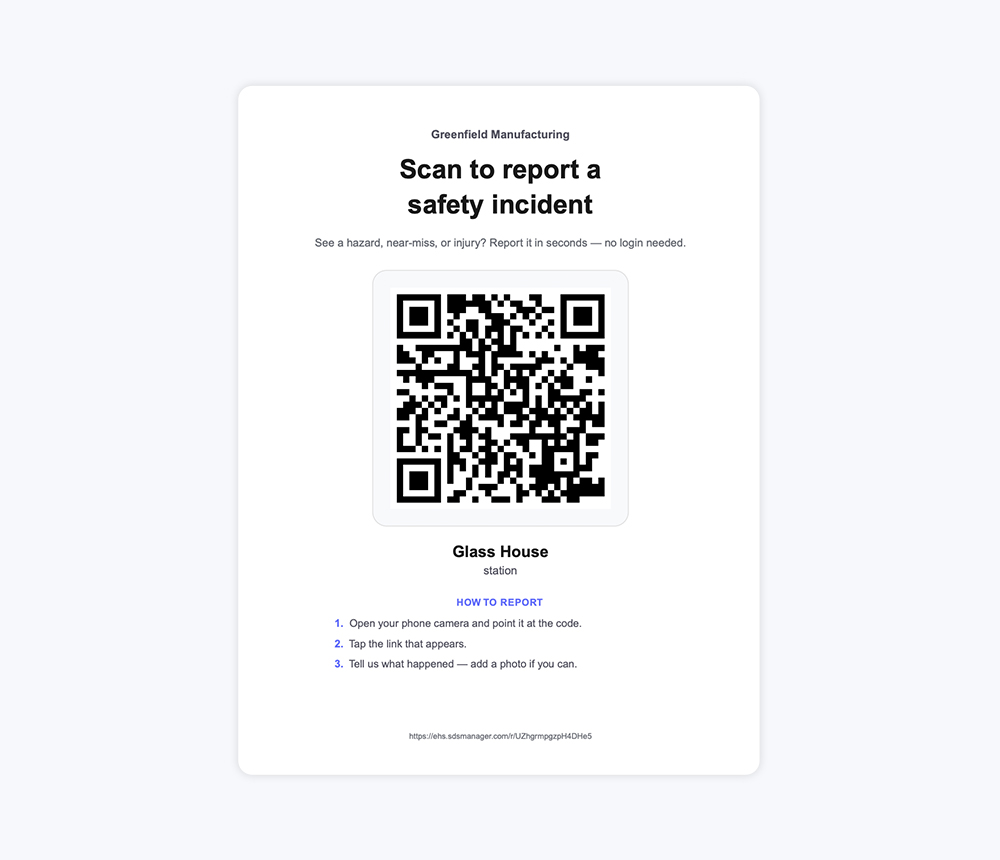
Mobile app, a QR poster at the workface with no login, a voice note or photo, or the full form from a desk — all landing as the same structured record
Forms it feeds
OSHA 300, 300A and 301 with ITA submission, RIDDOR reports, Australian WHS notifications
The difference

What changes when reporting takes thirty seconds.

Near miss reporting is free information, and it only reaches you if reporting is easier than not reporting. What separates these systems is what happens at the workface, not what the admin screen can hold.

Legacy EHS platforms compared with EHS Solutions by SDS Manager
ScenarioLegacy EHS platformsEHS Solutions by SDS Manager
A contractor spots a frayed lifting slingA form on a desktop, behind a login they don't have. It gets mentioned to someone, or it doesn't.A QR poster on the wall. Thirty seconds in any browser, anonymous if they want.
Someone reports at the end of a shiftFree-text boxes and a severity dropdown they aren't qualified to fill in.They say what happened. Severity gets decided at triage, by someone who can judge it.
An inspector asks about a case from MarchThe details were captured late, from memory, if at all.Witnesses, conditions, evidence and the reasoning behind every decision, captured while it was fresh.
  • Reported in thirty seconds

    A phone, a QR poster or a voice note, landing as the same structured record.

  • Every decision has a name on it

    Recordability, severity and closure are recorded calls with a reason attached.

  • Configured, not coded

    Your types, severity grid, questions and escalation rules are set in an admin panel, not built into the software.

See it running on your own process, not a demo dataset.Book a walkthrough
Capabilities

Everything that happens to a report, before anyone investigates

How it gets in, who gets told, how recordability is settled, and what closing a case actually means.

Bring us a real incident

Walk us through one you've actually handled — including the awkward parts — and we'll show you how it would run here.

Book a walkthrough

In practice

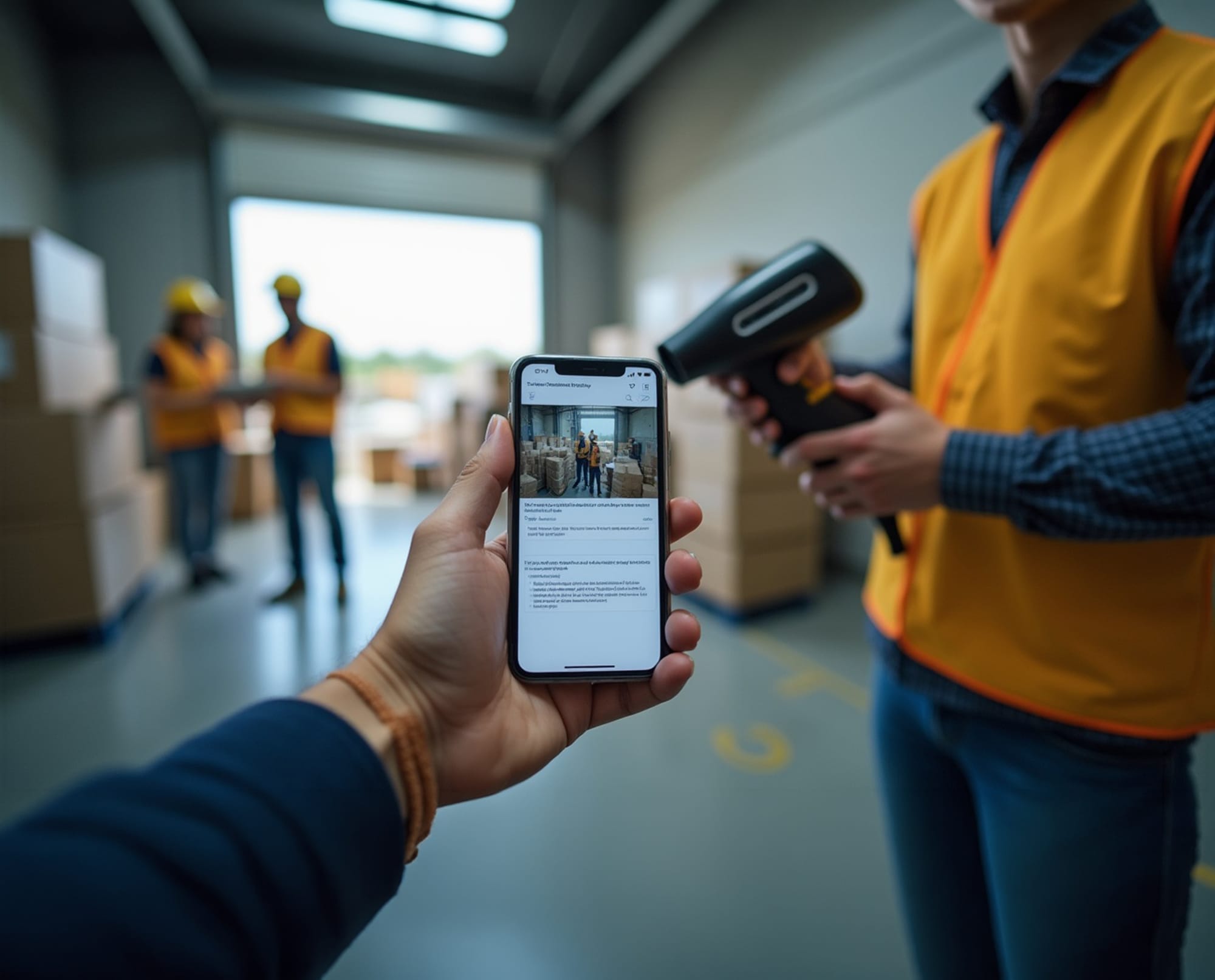
Workers reviewing safety records together on site
“Lads can put a near miss in from their phone at the board without setting up an account, which is the only reason any of them do it. Before this I'd hear about something two weeks later, if at all. Now it comes in the same day and I can go look while the site is still set up the way it was.”
Greg MulvaneyEHS Manager, commercial builder · 34 active sites, 2,600 peopleVerified review · Capterra
What it costs

The software is the invoice

Legacy vendors quote a licence, then bill the setup, the migration, the training days and every change afterwards. It's a relic of an era when software took a year to install.

You pay for the software, not the consultants.

Priced on headcount, however many sites you run. Under 200 people, start a free trial and go. Above that, ask us for a number and you'll get one.

On your invoice
  • The software
  • Every module
  • Your headcount
  • Setup of your rules
  • Reports built for you
  • Changes, whenever
  • Support
Never on your invoice
  • Implementation fee
  • Configuration project
  • Consulting hour blocks
  • Change requests
  • Professional services minimum
  • Data extraction on exit
  • No implementation fee
  • No professional services minimum
  • No hours to buy for changes
FAQ

Frequently asked questions

Still have questions? Our safety experts will answer them against your own process rather than generically.

Talk to our safety experts
Yes. A worker can report an incident without an account in EHS Solutions by SDS Manager: a QR poster at the point of work opens a form in any phone browser, with no app and no licence. The site and area are already attached because the poster is specific to that location, and the report can be anonymous.
An EHS officer decides. In EHS Solutions by SDS Manager the system works through the recording criteria and proposes an answer with its reasoning, but a person confirms it. If a question can't be answered yet, recordability stays pending rather than defaulting either way.
An incident classification can be changed, but only as a tracked decision. In EHS Solutions by SDS Manager a change to recordability or reportability is raised as a request with a reason, and approved by somebody other than the person who raised it — the system rejects self-approval. The request, the decision and the reasoning all stay in the case history, which cannot be edited afterwards.
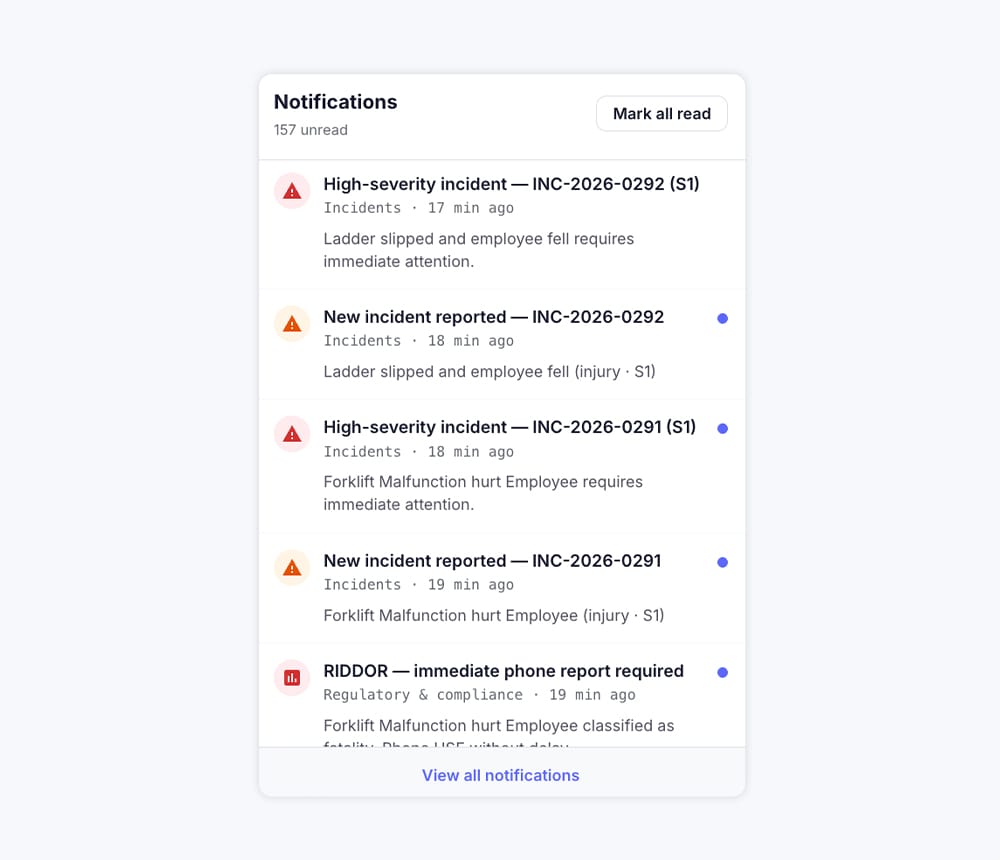
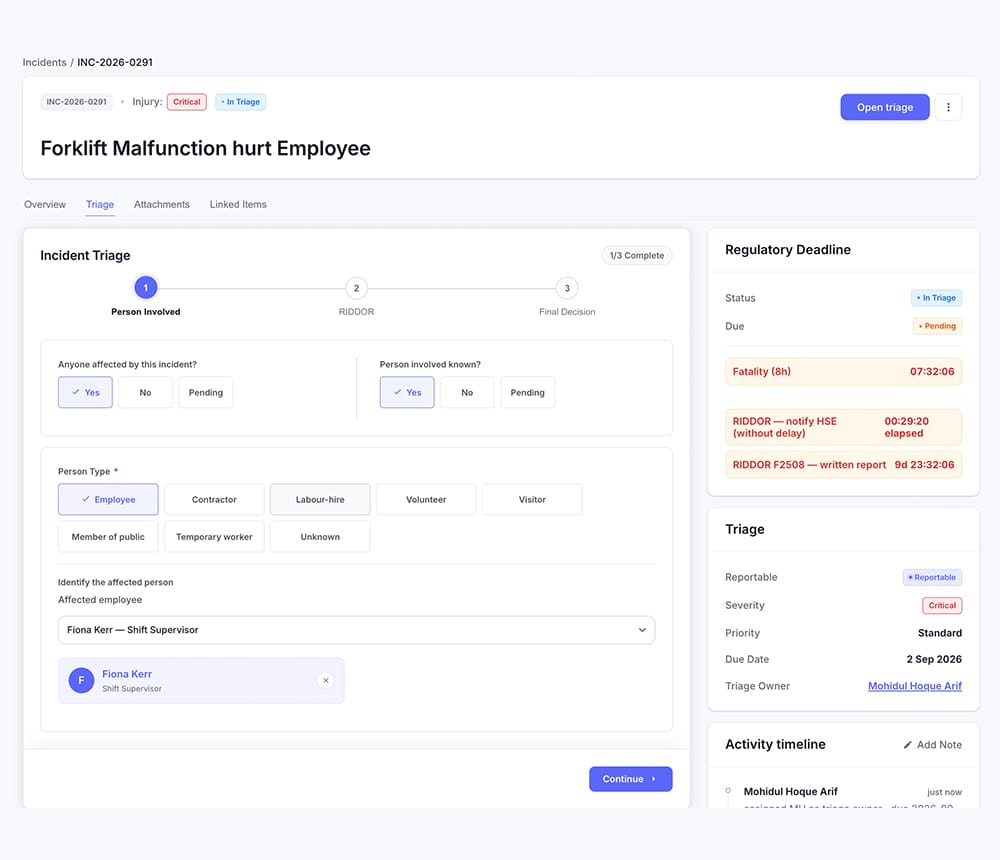
Regulatory notification deadlines run automatically from the moment a serious outcome is flagged. In EHS Solutions by SDS Manager the deadline is created and counts down on the case where people can see it. Making the call is logged with the office contacted and the reference given, and a discharged obligation is a permanent part of the record.
Yes. A closed incident can be reopened in EHS Solutions by SDS Manager by senior EHS roles, with a written reason. Reopening is recorded rather than hidden, which matters when facts change — a condition that worsened, or a late medical finding.
Yes. One incident record in EHS Solutions by SDS Manager holds as many injured people as it needs, each with their own injuries, treatment and outcome. Days away and restricted duty are tracked per person, so aggregate figures don't double-count.
Yes. EHS Solutions by SDS Manager handles near miss and hazard reporting through the same route as accidents. Near misses, hazards, unsafe conditions and observations use the same thirty-second report as an injury — which is the point, since those are the ones you want to hear about while nothing has happened yet.
Yes. EHS Solutions by SDS Manager produces OSHA 300, 300A and 301 from the incident record rather than retyping from it, along with ITA submission. The severe-injury notification clock starts and is tracked for you. RIDDOR reports and Australian WHS notifications work the same way, and the same approach extends to whichever regime applies to a given site.
When your process changes or a new regulation applies, EHS Solutions by SDS Manager is reconfigured rather than recoded. Each regulation and workflow is defined in a no-code admin panel: what to capture, which notifications to send, and the trigger and escalation points. A change is made in the panel, typically within a day, and isn't billed as a change request or against consulting hour blocks.
People use EHS Solutions by SDS Manager because reporting is easier than not reporting. A report takes a QR poster on the wall, a phone or a voice note, with no login and no severity dropdown to puzzle over — the judgement calls happen at triage, by someone qualified to make them. Systems get abandoned when the person at the workface is asked to do the safety manager's job at six in the morning.
Setup takes days, and your team's part is describing how you already work. In EHS Solutions by SDS Manager your incident types, severity grid, triage questions, notification rules and escalation points are configured before go-live, by our team. There's no implementation fee and no consulting hours to buy.
Yes. Existing incident history can be moved into EHS Solutions by SDS Manager, so your logs and year-on-year figures stay continuous rather than starting from zero. It isn't billed as a separate migration project.
Chemical and SDS management connects directly, because EHS Solutions by SDS Manager is built by SDS Manager, whose core product is a chemical and safety data sheet compliance database. When an incident involves a substance, the safety data sheet is attached to the case from that database, so an investigator reading the record has the hazard information in front of them rather than in another system. SDS Manager is part of the NetPower group, headquartered in Norway with offices in the United States, Vietnam and Bangladesh.
Ready when you are

Bring us a real incident

Walk us through one you've actually handled — including the awkward parts — and we'll show you how it would run here.