












Safety Data Sheet Management System | Online MSDS software
Overview

A connected EHS platform across audit, incident and risk in one place.

Audit & Inspection

Standardise inspections and audits — schedule, capture findings and close actions.

Incident Management

Report, investigate and learn from incidents with real-time field reporting.

CAPA Management

Track CAPAs with owners, due dates and independent sign-off before closure.

Incident Investigation

Guided 5 Whys, fishbone and decision-tree investigations with defensible evidence.

Safety Training

Assign by role and site, and catch expiring certifications before they lapse.

Compliance Reporting

OSHA 300, RIDDOR and WHS output produced from the records you already hold.

Risk Management

Identify, assess and control workplace risk across every site and team.

Contractor Management

Approval before they start, documents that carry their expiry, and every company on one register.

SDS Management

Build, organise and share your SDS library with QR-code access for employees.

ExactSDS

Author your own GHS-compliant Safety Data Sheets in 40+ languages.

DirectSDS

Distribute your SDSs directly to customers and partners — no email needed.

Risk Assessment

Assess chemical risks across your workplace and document required controls.

Chemical Inventory Management

Track inventory, approvals and restricted-substance lists across locations.

Free SDS Search

Search 30 million+ Safety Data Sheets — free, no account needed.

Free SDS Management Tool

Manage your SDS library with our free tool — no credit card required.

Secondary Label Generator

Generate GHS-compliant secondary container labels in seconds.

Transport Label Generator

Print ADR / DOT compliant transport labels straight from any SDS.

Pricing
About UsOur mission and the story behind SDS Manager.Our TeamMeet the people building chemical safety software.CertificationsSecurity, privacy and quality standards we comply with.Contact UsReach our sales and support teams.
ArticlesIn-depth guides on SDS management and EHS compliance.NewsLatest chemical safety and HSE updates from around the world.WebinarsLive sessions and on-demand recordings from our safety experts.
Customer StoriesHow real companies use SDS Manager to stay compliant.Content LibraryFree templates, checklists and whitepapers you can download.Help & FAQSearchable knowledge base and answers from our support team.
US News

TEST NEWS SCHEDULE B

Read more
EU News

Regulations that Chemical Retailers must know being the Responsible Party to provide SDS

Read more

eu

auatcacndedkeleseeeufifr
hihuidisitjpltlvmtnlnonz
plptrorusesksltruaukusvn

EHS compliance reporting software

EHS compliance reporting, without the year-end rebuild

Injury and illness recordkeeping that produces its own forms — OSHA 300, 300A and 301, RIDDOR reports, WHS notices — with notification clocks that start themselves and rates calculated as you go.

Book a walkthroughStart free trial
Safety and compliance team reviewing reports
Trusted by10,000+ Safety Managers
Porsche
DeLonghi
Zircoa
Unilever
DHL
Thule
TESMEC
ISAVIA
Innvik AS
DAHLRAIL
Hans Claussen AS
Isfjord Norway
Heide & Cook, LLC
Porsche
DeLonghi
Zircoa
Unilever
DHL
Thule
TESMEC
ISAVIA
Innvik AS
DAHLRAIL
Hans Claussen AS
Isfjord Norway
Heide & Cook, LLC

Every jurisdiction gives you a window. None of them are long.

In the US, 29 CFR 1904.40 gives you four business hours to produce injury records once an inspector asks. A RIDDOR specified injury is reported without delay. Australian WHS requires immediate notification. The form has to exist before the window opens.

Also called
OSHA recordkeeping software, injury and illness reporting software, RIDDOR reporting software
Forms produced
OSHA 300, 300A and 301 with an ITA-ready export, RIDDOR reports, WHS notifiable incident notices
Who files
You do. We produce the completed forms and the validated ITA file — the declaration stays yours.
The difference

What changes when the form comes out of the record.

A regulator asking for your injury records does not wait while you assemble them, and a serious outcome starts its notification clock whether anyone noticed or not. The form has to exist before the window opens.

Legacy EHS platforms compared with EHS Solutions by SDS Manager
SituationLegacy EHS platformsEHS Solutions by SDS Manager
The inspector asks for your 300 log Legacy EHS platformsProduced from the system, if recordability decisions were kept current — which often means a year-end rebuild happened first. EHS Solutions by SDS ManagerProduced from the records as they stand. The log was never a separate exercise.
You need a form the system doesn't have Legacy EHS platformsYou get a builder. Configuring it is technical work, and it lands on the safety manager — or on a professional services engagement. EHS Solutions by SDS ManagerOur team builds it, typically within a day. Nothing for you to configure and nothing billed against consulting hours.
A regulation or threshold changes Legacy EHS platformsA release to wait for, or a change request to pay for. EHS Solutions by SDS ManagerYou tell us. It's live the next day.

Each site follows the rules that apply to it — a US plant, a UK depot and an Australian site can run different regimes in one system.

  • Your regimes, set up by us

    Thresholds, forms and deadlines configured to your sites before go-live.

  • Every site on its own rules

    A US plant, a UK depot and an Australian site, each following what applies to it.

  • You keep the filing

    We produce the completed forms and the validated ITA file. The declaration stays yours.

See it running on your own process, not a demo dataset.Book a walkthrough
Capabilities

Everything the regulator asks for, ready before they ask

The statutory forms, the deadlines attached to them, and the injury rates you report — all worked from the same records your team already made.

Statutory forms

Get the forms without retyping anything

Most of the work in statutory reporting is transcription — moving what you already know into a prescribed layout, months after the fact. That step disappears when the form reads the case directly.

  • The forms your jurisdiction requires OSHA 300, 300A and 301 with an ITA-ready export, RIDDOR reports and WHS notices.
  • Recordability decided as you go Work-relatedness is settled at triage while facts are fresh, so year end is a review.
  • Corrections shown as corrections Amend a case and the previous value stays visible, the way recordkeeping rules expect it.
  • Privacy concern cases handled as defined The name is withheld from the log and kept on a separate confidential list.
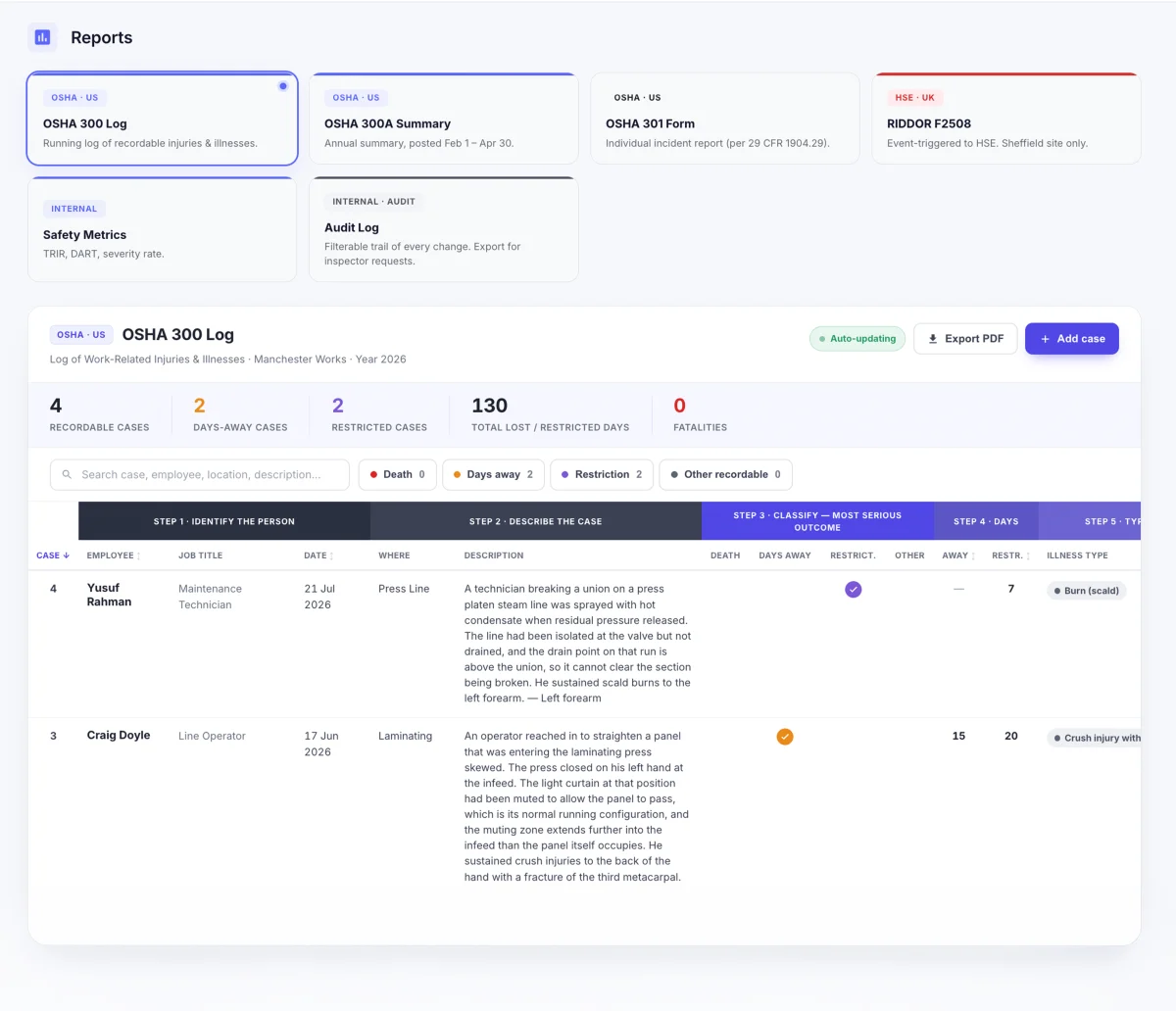
The reports list and the OSHA 300 log, built from recorded cases
Notification deadlines

Never miss a notification window

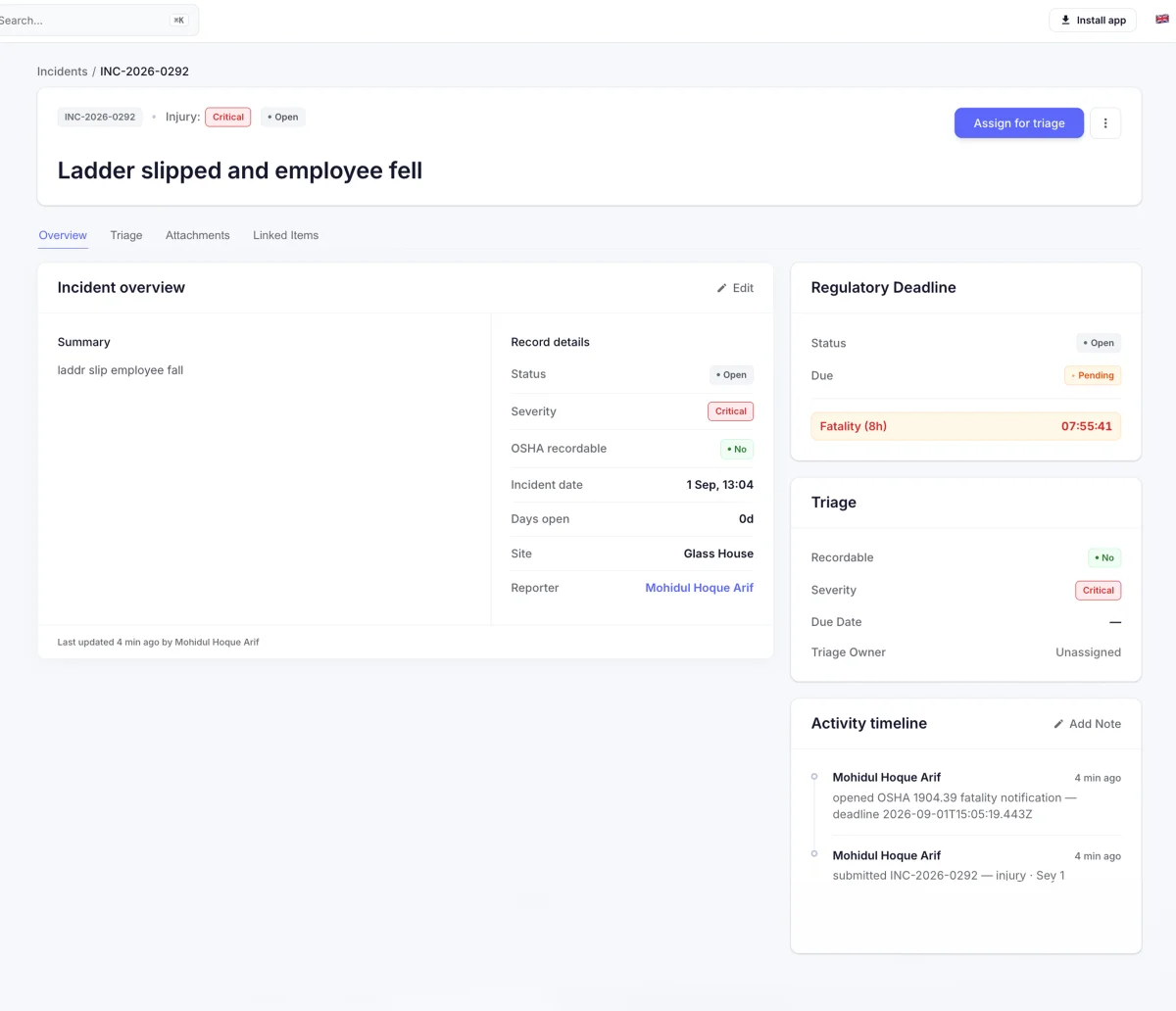
Notification windows are short and they start whether anyone noticed or not — eight hours for a fatality, twenty-four for a hospitalization or amputation. A clock nobody started is the most expensive administrative miss there is.

  • Started automatically, counted down visibly Flag a serious outcome and the deadline appears on the case with the time remaining.
  • The right clock for the jurisdiction US severe-injury windows, RIDDOR's phone and written deadlines, the WHS period, each as defined.
  • The call is logged when it's made The office, the reference and who made it, so a discharged obligation is evidence.
  • Nothing waits on someone being at a desk Unpicked-up cases escalate to administrators, and the clock doesn't pause over a weekend.
An incident record with its regulatory deadline counting down
TRIR & DART

TRIR and DART, calculated from your records

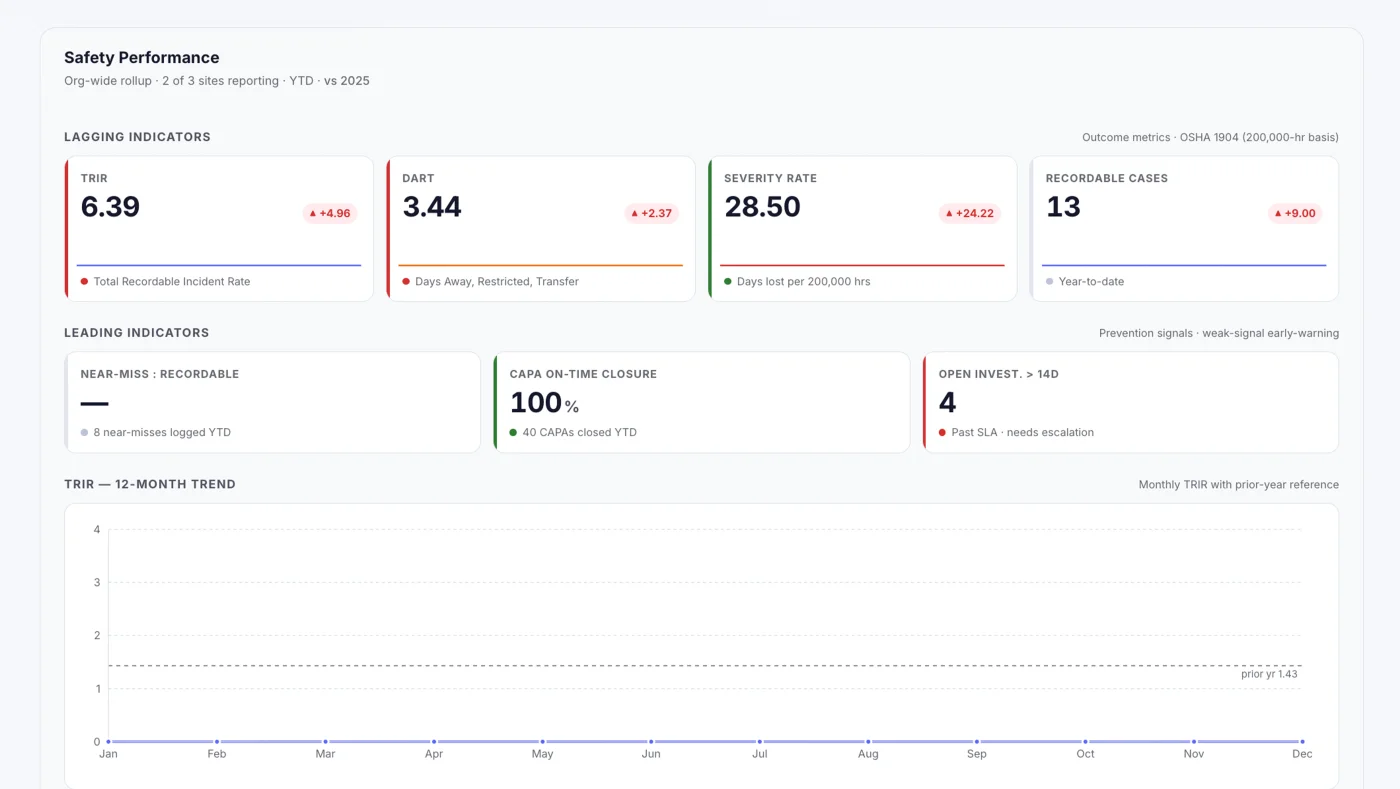
TRIR and DART get rebuilt in a spreadsheet each quarter, usually by one person, usually differently each time. Worked from the same records as the forms, the rate you report and the log you'd hand over agree.

  • The standard rates, calculated for you Recordable rate, DART, lost-time and severity, worked from your cases and the hours entered.
  • Employee and contractor hours kept separate Contractor exposure is reported alongside your own rate rather than folded into it.
  • Comparable between sites and over time One definition applied everywhere, so a comparison between sites is real and a trend holds.
  • A history that can be checked Every change is recorded permanently, so a figure traces back to the entries behind it.
A safety performance dashboard showing TRIR, DART and a 12-month trend
Record retention

Five years of records come with you

1904.33 requires you to keep the 300 log, the annual summaries, the 301 forms and the privacy case list for five years after the year they cover. Switching systems doesn't reset that.

  • Your prior logs come across at onboarding Spreadsheets or exports from an old system, brought in as complete years rather than cases.
  • Retained years stay reportable A prior year can be produced as a statutory form on demand, not just viewed.
  • The privacy case list moves too Withheld names and the confidential list stay separated the way the rule actually requires.
  • One five-year view, not two systems An inspector asking for 2023 and 2027 gets both from the same place, immediately.
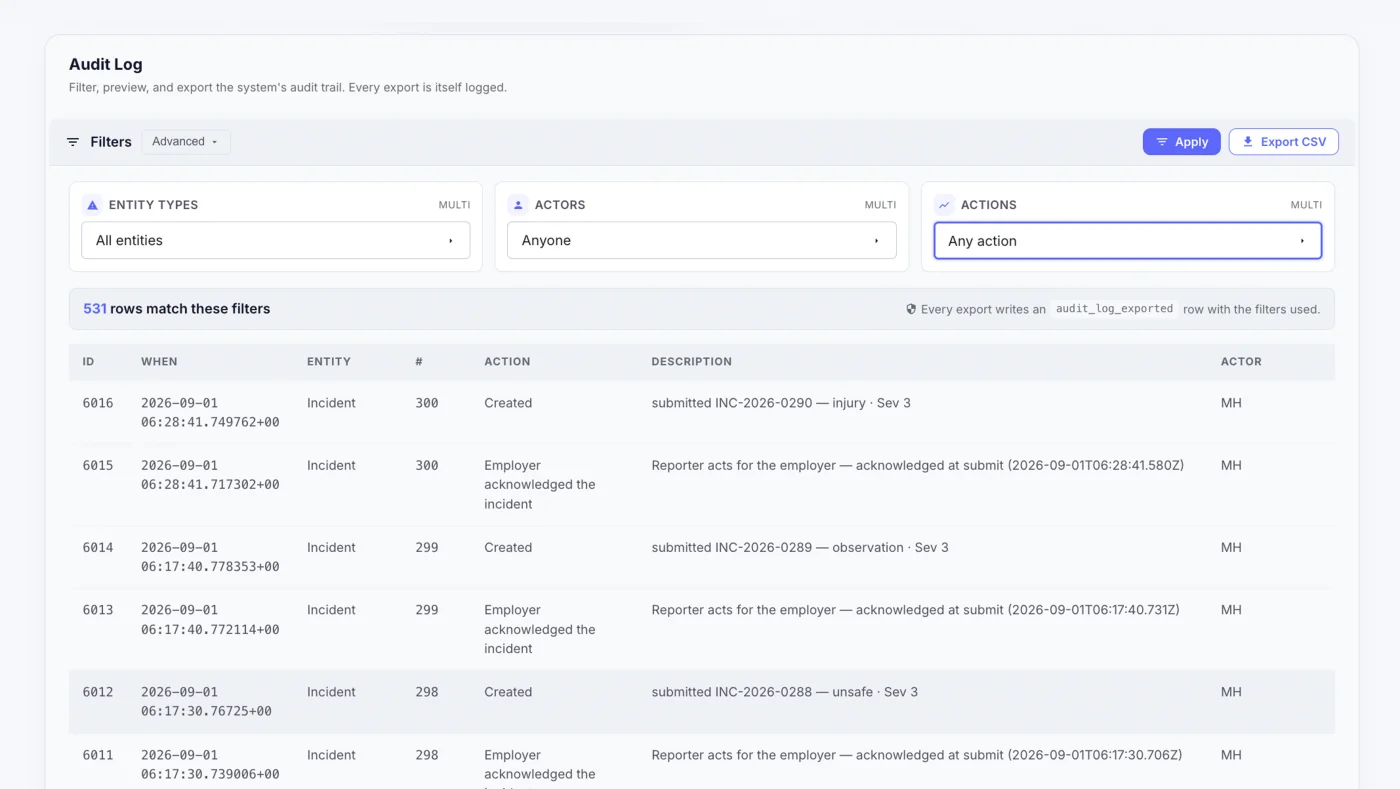
The audit log, filtered and ready to export

Bring us last year's 300 log

Or your RIDDOR submissions. We'll show you the same output coming straight out of the records.

Book a walkthrough

In practice

Operator reviewing records on a production line
“Somebody files, a reviewer decides whether it is reportable and to whom, and the clock runs from there against the right regime. We operate across two countries with different thresholds and I no longer keep a personal list of dates in a notebook.”
Compliance DirectorHealthcare provider group · 3,100 employees, EMEA
One system

Compliance reporting is one part of the platform

The forms and clocks on this page are built from records made everywhere else in the system — incidents, investigations, actions, inspections and training, all on one site structure and one history.

Incident ManagementReport injuries, near-misses and hazards from any device, then triage and classify them.Incident InvestigationGuided 5 Whys, fishbone and decision-tree investigations with evidence you can defend.CAPA ManagementOwners, due dates and independent sign-off, linked back to the finding that raised them.Risk ManagementIdentify hazards, score risk on your own matrix and track the controls that reduce it.Contractor ManagementApproval before they start, documents that carry their expiry, and every company on one register.Audit & InspectionMobile checklists, recurring schedules and consistent scoring across every site.Safety TrainingAssignment by role and site, with certification expiry surfaced before it lapses.
Assets & MaintenanceEquipment register with preventive maintenance and calibration schedules and pass or fail outcomes.
Document ControlVersioned policies and certificates with expiry tracking and full change history.
What it costs

The software is the invoice

Legacy vendors quote a license, then bill the setup, the migration, the training days and every change afterwards. It's a relic of an era when software took a year to install.

You pay for the software, not the consultants.

Priced on headcount, however many sites you run. Under 200 people, start a free trial and go. Above that, ask us for a number and you'll get one.

On your invoice
  • The software
  • Every module
  • Your headcount
  • Setup of your rules
  • Reports built for you
  • Changes, whenever
  • Support
Never on your invoice
  • Implementation fee
  • Configuration project
  • Consulting hour blocks
  • Change requests
  • Professional services minimum
  • Data extraction on exit
  • No implementation fee
  • No professional services minimum
  • No hours to buy for changes
FAQ

Frequently asked questions

Still have questions? Our compliance experts will answer them against your own process rather than generically.

Talk to our compliance experts
EHS compliance reporting software turns the safety records your team already keeps into the statutory output regulators require — the recordkeeping log, the annual summary, the incident report forms, the notifications — and tracks the deadlines attached to them. EHS Solutions by SDS Manager does this from the incident record itself. The alternative is transcription: re-entering known information into prescribed layouts, usually late and usually under pressure.
The difference between a recordable and a reportable injury is what you do with it: a recordable injury goes on your OSHA 300 log, while a reportable injury must be notified to OSHA directly. Recordable means it meets OSHA's recording criteria — death, days away from work, restricted work or transfer, medical treatment beyond first aid, loss of consciousness, or a significant diagnosis by a licensed healthcare professional. Reportable means a severe outcome: a fatality within 8 hours, and an in-patient hospitalization, amputation or loss of an eye within 24 hours. Every reportable injury is also recordable, but most recordable injuries are not reportable. In EHS Solutions by SDS Manager both decisions are settled at triage, so the log entry and the notification clock start from the same call.
EHS Solutions by SDS Manager produces OSHA 29 CFR 1904 recordkeeping forms — 300, 300A and 301 plus an ITA-ready export — RIDDOR reports in the UK, and notifiable incident notices under Australian WHS legislation. Because reportability thresholds are configured per customer in a no-code rule pack engine, the same approach extends to other national regimes, your group's internal standard, or whatever your insurer requires.
You have to keep OSHA 300 logs for five years following the end of the calendar year they cover, under 29 CFR 1904.33. The same five-year retention applies to the 300A annual summaries, the 301 incident report forms and the privacy case list. During that period you must also update the 300 log if you discover a recordable case you missed, though the 300A and 301 don't have to be updated. In EHS Solutions by SDS Manager retained years stay produceable as forms rather than only viewable as data, and prior records are brought across at onboarding so the five-year view survives a system change.
The OSHA 300A annual summary must be certified by a company executive and posted where employees can see it from 1 February to 30 April of the year following the year it covers. Separately, the electronic submission through OSHA's Injury Tracking Application is due by 2 March. EHS Solutions by SDS Manager tracks both dates per establishment, so the certification, the posting period and the submission each appear as deadlines rather than as something someone has to remember.
Notification deadlines start when a serious outcome is identified on a case, and in EHS Solutions by SDS Manager the relevant clock is created automatically and counts down on the record where people can see it. Making the call is logged with the office contacted and the reference received, so a discharged obligation is permanent evidence rather than someone's recollection. If a serious case hasn't been picked up, administrators are alerted, because the clock doesn't pause for a weekend.
No — and be careful of anyone who claims otherwise for every jurisdiction. EHS Solutions by SDS Manager produces the completed forms and, for OSHA's electronic submission, a validated file ready to upload. The filing itself stays with you, because that's a legal declaration by your organisation.
TRIR and DART are calculated from your recorded cases and the employee hours you enter, using the standard 200,000-hour basis. In EHS Solutions by SDS Manager contractor hours are reported separately rather than folded into your rate, and because the rates come from the same records as the forms, the number you report and the log you'd hand an inspector agree.
If you need a report we don't already have, our team builds it, typically within a day — a regulation we haven't listed, your group's internal standard, or a format your insurer specifies. It isn't a builder handed over for your safety manager to learn, and it isn't billed against consulting hours. Statutory forms are already in the system; anything beyond them is a request, not a project.
Yes, one system can handle sites in different countries, and that's the point of separating reportability from the software. Records are kept per establishment, which is OSHA's unit rather than the company's — so each site follows the regime and thresholds that apply to it, keeps its own log, and certifies its own 300A, while group-level figures still roll up. A US plant, a UK depot and an Australian site don't need three different tools.
Yes, your existing OSHA 300 logs come across at onboarding. Spreadsheets, exports from a previous system or a structured import are brought in as complete years rather than loose cases, so the five-year retention 1904.33 requires isn't split between an old system and a new one. The privacy case list moves with the same separation the rule requires.
A recordability decision can change, and in EHS Solutions by SDS Manager the change is a recorded decision rather than an edit. It's raised with a reason and approved by someone other than the person requesting it, and both the original call and the revised one stay readable — which is exactly what a line-out correction is supposed to preserve.
Chemical and SDS management connects directly, because EHS Solutions by SDS Manager is built by SDS Manager, whose core product is a chemical and safety data sheet compliance database. When an illness or exposure case involves a substance, the safety data sheet sits in the same system as the record that produces the statutory form, rather than in a separate library somebody has to go and search. SDS Manager is part of the NetPower group, headquartered in Norway with offices in the United States, Vietnam and Bangladesh.

Bring us last year's 300 log

Or your RIDDOR submissions. We'll show you the same output coming straight out of the records.
Book a walkthroughorStart free trial
Set up around the regimes, thresholds and deadlines that apply to your sites.

SDS Manager AS

  • Safety Data Sheet management for users of chemicals, retailers, webshops and manufacturers

Solutions

  • SDS Manager - SDS Management, Compliance & Employee Access
  • DirectSDS - SDS Distribution for eCommerce and Distributors
  • ExactSDS - SDS Authoring, Creation & Translation

Free Tools & Services

  • Free SDS Search with Update Notifications
  • Free SDS Management Tool for Small Businesses
  • Free generator for Secondary Container Labels
  • Free Tool for Generating Transport Labels

Company

  • About Us
  • Partner Program
  • Contact Us

Address

Thunesvei 2, 0274 Oslo Norway

+44 20 3936 1240

Privacy PolicyTerms and ConditionsCertificationsService Fulfillment Policy
©2026 SDS Manager |All rights reserved