












Safety Data Sheet Management System | Online MSDS software
Overview

A connected EHS platform across audit, incident and risk in one place.

Audit & Inspection

Standardise inspections and audits — schedule, capture findings and close actions.

Incident Management

Report, investigate and learn from incidents with real-time field reporting.

CAPA Management

Track CAPAs with owners, due dates and independent sign-off before closure.

Incident Investigation

Guided 5 Whys, fishbone and decision-tree investigations with defensible evidence.

Safety Training

Assign by role and site, and catch expiring certifications before they lapse.

Compliance Reporting

OSHA 300, RIDDOR and WHS output produced from the records you already hold.

Risk Management

Identify, assess and control workplace risk across every site and team.

Contractor Management

Approval before they start, documents that carry their expiry, and every company on one register.

SDS Management

Build, organise and share your SDS library with QR-code access for employees.

ExactSDS

Author your own GHS-compliant Safety Data Sheets in 40+ languages.

DirectSDS

Distribute your SDSs directly to customers and partners — no email needed.

Risk Assessment

Assess chemical risks across your workplace and document required controls.

Chemical Inventory Management

Track inventory, approvals and restricted-substance lists across locations.

Free SDS Search

Search 30 million+ Safety Data Sheets — free, no account needed.

Free SDS Management Tool

Manage your SDS library with our free tool — no credit card required.

Secondary Label Generator

Generate GHS-compliant secondary container labels in seconds.

Transport Label Generator

Print ADR / DOT compliant transport labels straight from any SDS.

Pricing
About UsOur mission and the story behind SDS Manager.Our TeamMeet the people building chemical safety software.CertificationsSecurity, privacy and quality standards we comply with.Contact UsReach our sales and support teams.
ArticlesIn-depth guides on SDS management and EHS compliance.NewsLatest chemical safety and HSE updates from around the world.WebinarsLive sessions and on-demand recordings from our safety experts.
Customer StoriesHow real companies use SDS Manager to stay compliant.Content LibraryFree templates, checklists and whitepapers you can download.Help & FAQSearchable knowledge base and answers from our support team.
US News

TEST NEWS SCHEDULE B

Read more
EU News

Regulations that Chemical Retailers must know being the Responsible Party to provide SDS

Read more

eu

auatcacndedkeleseeeufifr
hihuidisitjpltlvmtnlnonz
plptrorusesksltruaukusvn

Risk management software

Stop rebuilding your risk register before every audit

Risk assessment software that scores every risk on one matrix, records what you did about it, and brings each one back for review on its own.

Book a walkthroughStart free trial
Two workers assessing risk on a tablet in a warehouse
Scored the same way everywhere

One risk matrix and one set of bands, so a comparison between sites is a real comparison.

Controls ranked, not just listed

Elimination through to PPE, so a register leaning on training is visibly the weak kind.

Nothing goes stale quietly

Every risk carries a review date and an owner, and overdue ones surface rather than pass.

Trusted by10,000+ Safety Managers
Porsche
DeLonghi
Zircoa
Unilever
DHL
Thule
TESMEC
ISAVIA
Innvik AS
DAHLRAIL
Hans Claussen AS
Isfjord Norway
Heide & Cook, LLC
Porsche
DeLonghi
Zircoa
Unilever
DHL
Thule
TESMEC
ISAVIA
Innvik AS
DAHLRAIL
Hans Claussen AS
Isfjord Norway
Heide & Cook, LLC

A register is only worth what it says on the day someone asks

Every system can store a list of risks with scores against them. The question is whether two people scoring the same hazard land on the same number, whether the score moved after you spent money, and whether anything brings it back before it goes stale.

Also called
Risk assessment software, risk register software
How scoring works
Likelihood by consequence on a 5×5 matrix, with the bands, wording and thresholds set to match how you already grade risk
Standards it supports
ISO 45001 clause 6.1.2, hazard identification and assessment, and clause 8.1.2, hierarchy of controls
The difference

What changes when one matrix holds the scoring.

Legacy EHS platforms compared with EHS Solutions by SDS Manager
SituationLegacy EHS platformsEHS Solutions by SDS Manager
Three supervisors assess the same hazard Legacy EHS platformsThree different scores, and a register that stops being comparable between sites. EHS Solutions by SDS ManagerOne likelihood-by-consequence matrix with your bands, so the number means the same thing everywhere.
You spend six months installing a control Legacy EHS platformsThe register still shows the score you started with. The improvement is asserted, not shown. EHS Solutions by SDS ManagerScored again after controls, so a move from 20 to 6 is on the record, and a control that changed nothing is just as visible.
A review was due last quarter Legacy EHS platformsNobody notices until somebody opens the spreadsheet before an audit. EHS Solutions by SDS ManagerThe risk comes back on its own with its history attached, and overdue reviews sit in a queue rather than passing quietly.
See it running on your own register, not a demo dataset.Book a walkthrough
Capabilities

Assess it, control it, and score it again

How a risk gets scored the same way everywhere, what your controls actually did to the number, and how each one comes back before it goes stale.

Risk assessment

One risk matrix, not three opinions

Ask three supervisors to rate a hazard and you get three answers, which is why registers stop being comparable. Scoring runs off one matrix instead of judgment.

  • One risk matrix, everywhere. Likelihood against consequence on a 5×5 matrix, with the bands and labels set to match how your organization already grades risk.
  • A threshold that triggers something. When an inherent score crosses the threshold you set, the risk requires controls before it sits in the register as it is.
  • Hazard identification where the work is. Risks can be raised from an incident, an investigation or an inspection round, so a hazard enters the register from what somebody actually saw.
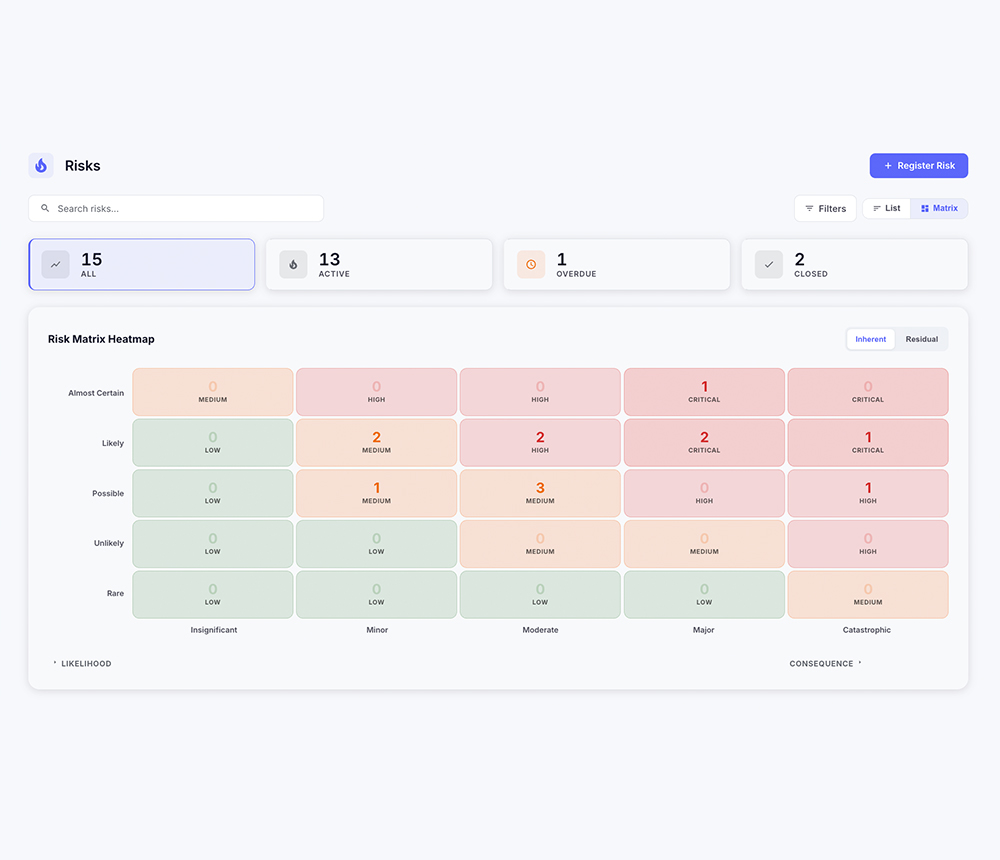
The 5x5 risk matrix, with likelihood scored against consequence
Hierarchy of controls

Show what the money actually bought

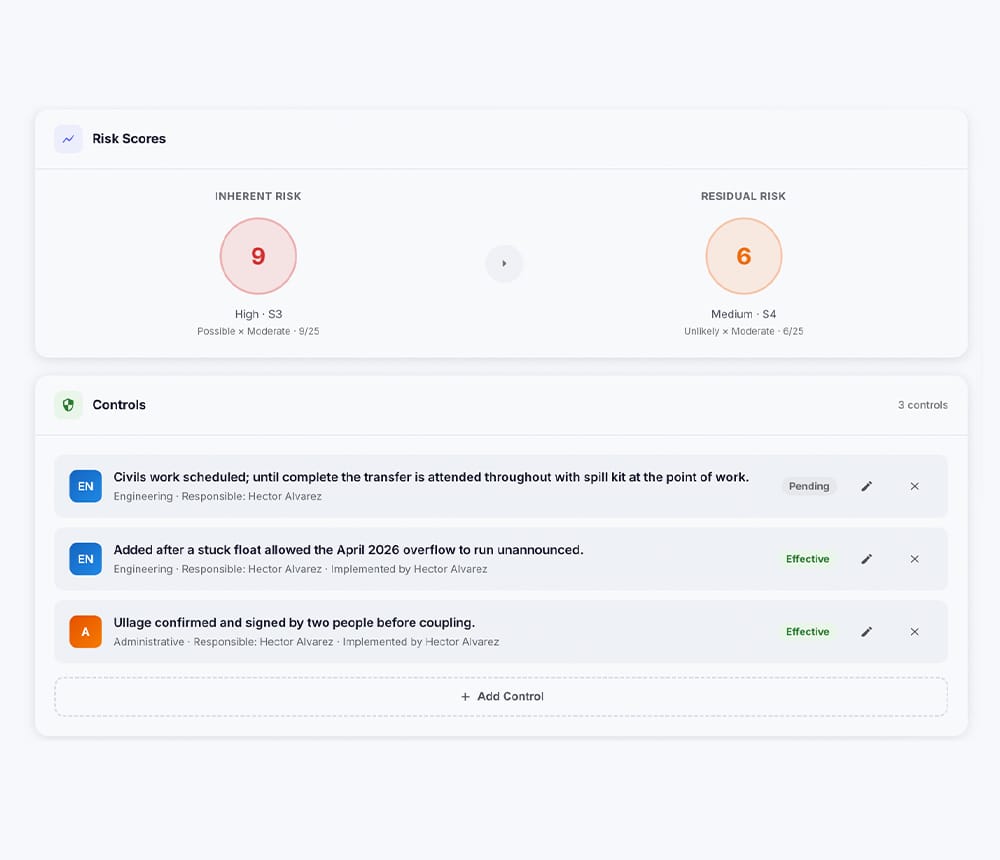
A control that took six months and moved the score by two points is worth knowing about. So is one that moved it by fourteen.

  • Controls ranked the way the standard expects. Control measures are recorded as elimination, substitution, engineering, administrative or PPE, so a register full of PPE and training is visibly the weak kind.
  • Inherent and residual, side by side. The same assessment scored again after controls are in place, so the before and after is on the record rather than asserted.
  • Accepting a risk is a recorded decision. Where residual risk is judged as low as reasonably practicable, it's accepted by name with a written justification rather than left ambiguous.
Inherent against residual risk, with the controls that reduced it
Risk register

The review comes back without you remembering it

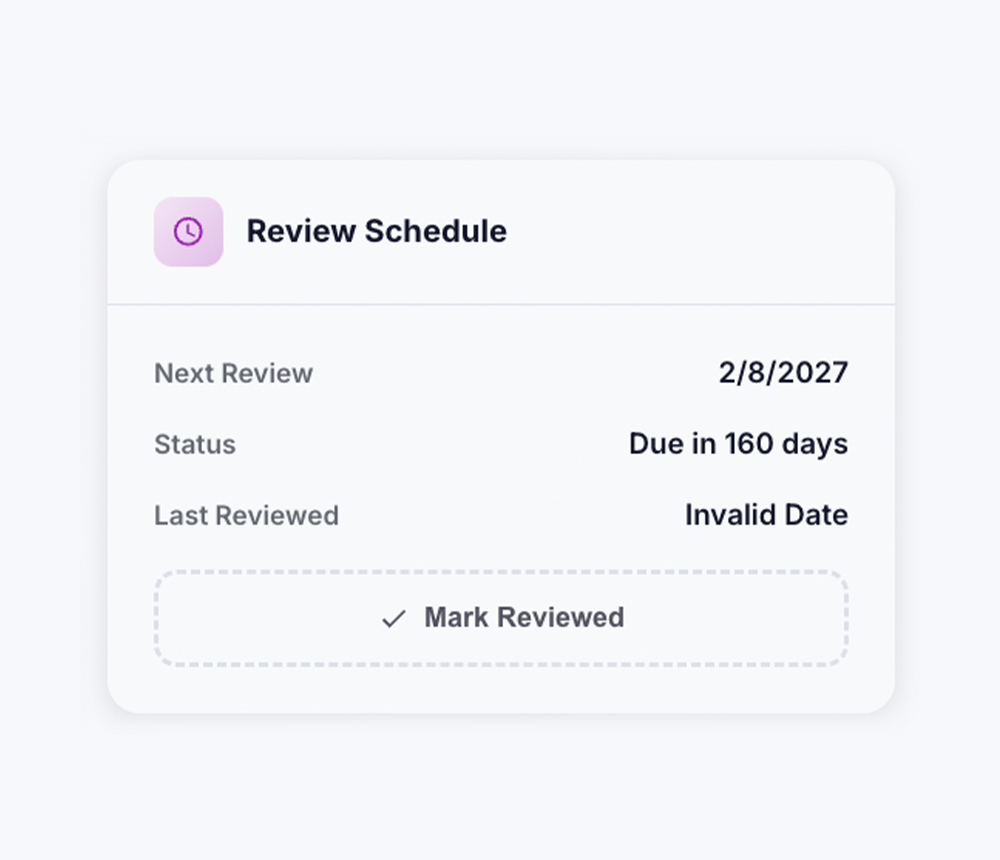
A register that only gets touched before an audit isn't a register, it's a document. Every risk carries a date and an owner.

  • Review dates that advance on their own. Reviews run on the cycle you set, with reminders before and escalation after.
  • Overdue sits in a queue. A review that slipped is visible as a queue rather than passing quietly until somebody opens the spreadsheet.
  • The whole matrix at a glance. Where every risk sits now, per site or across the group, without assembling it from anywhere.
The risk review queue, with each entry's next review date
Connected records

A risk that keeps producing incidents is impossible to miss

A register that sits apart from what actually happens is a register that describes a different building.

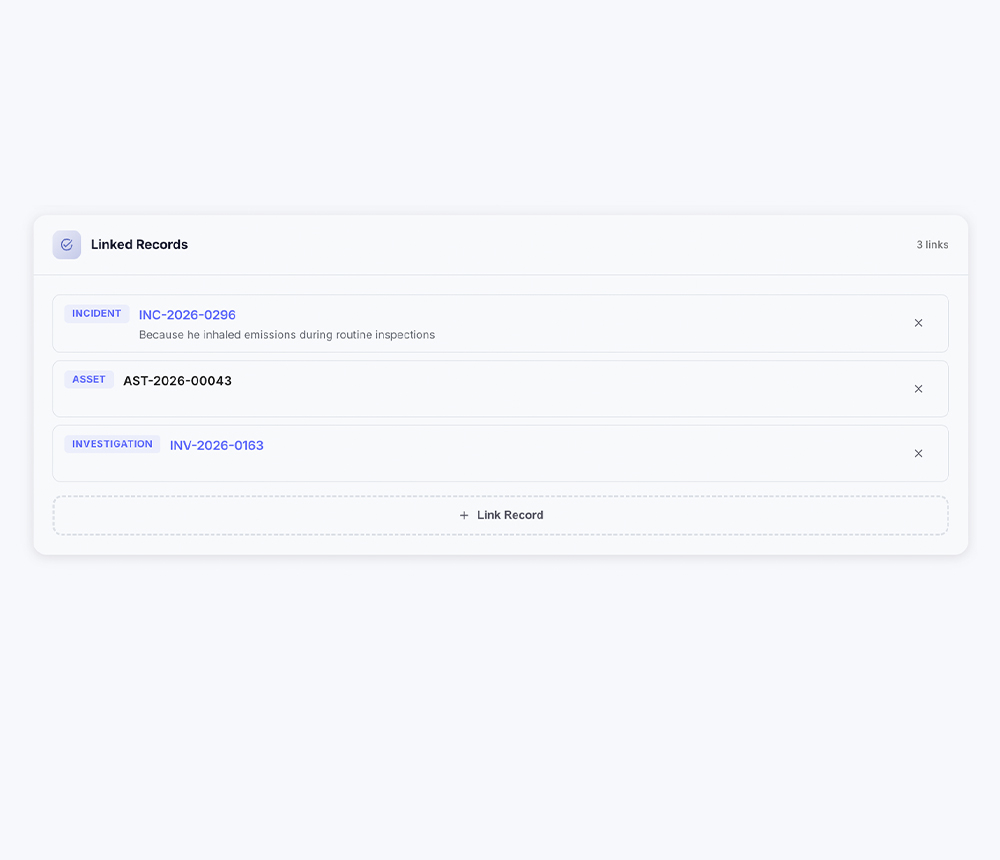
  • Linked to what happened. Risks connect to the incidents, investigations, actions and assets involved, so the register reflects the site rather than an assessment workshop.
  • Findings become risks. An inspection finding can add a risk directly, and a recurring one raises the question rather than waiting to be noticed.
  • Actions feed the score back. A corrective action taken against a register entry feeds into the residual position once it's verified.
A risk register entry with its linked incidents, actions and assessments

Bring us your risk register

Send us the spreadsheet you have now and we'll show you what it looks like scored, controlled and on a review cycle.

Book a walkthrough

In practice

Two workers reviewing a risk assessment on a tablet in a warehouse
«The risk register is the part I use most. I can show our management review what our control work actually changed, rather than asserting it.»
Pavel UrbanBrno Precision Parts · Automotive, Czech Republic
One system

The risk register is one part of the platform

A risk can be raised from an inspection finding, updated by an incident's root cause, and closed out by a corrective action, on one site structure and one history.

Incident ManagementReport injuries, near-misses and hazards from any device, then triage and classify them.Incident InvestigationGuided 5 Whys, fishbone and decision-tree investigations with evidence you can defend.CAPA ManagementOwners, due dates and independent sign-off, linked back to the finding that raised them.Contractor ManagementApproval before they start, documents that carry their expiry, and every company on one register.Audit & InspectionMobile checklists, recurring schedules and consistent scoring across every site.Safety TrainingAssignment by role and site, with certification expiry surfaced before it lapses.Compliance ReportingOSHA 300, 300-A and 301, RIDDOR and WHS output produced from the records you already hold.
Assets & MaintenanceEquipment register with preventive maintenance and calibration schedules and pass or fail outcomes.
Document ControlVersioned policies and certificates with expiry tracking and full change history.
What it costs

The software is the invoice

Legacy vendors quote a license, then bill the setup, the migration, the training days and every change afterwards. It's a relic of an era when software took a year to install.

You pay for the software, not the consultants.

Priced on headcount, however many sites you run. Under 200 people, start a free trial and go. Above that, ask us for a number and you'll get one.

On your invoice
  • The software
  • Every module
  • Your headcount
  • Setup of your rules
  • Reports built for you
  • Changes, whenever
  • Support
Never on your invoice
  • Implementation fee
  • Configuration project
  • Consulting hour blocks
  • Change requests
  • Professional services minimum
  • Data extraction on exit
  • No implementation fee
  • No professional services minimum
  • No hours to buy for changes
Frequently asked questions

Risk management, answered.

Still have questions? Our safety experts will answer them against your own register rather than generically.

Talk to our risk management experts
Risk assessment software records the hazards you've identified, scores how serious each one is, tracks the controls put in place against it, and brings each risk back for review on a cycle. In EHS Solutions by SDS Manager it sits in the same system as incidents, investigations, actions and inspections, so a risk that keeps producing incidents is visible and a control that came out of an investigation is linked to it.
The difference between inherent and residual risk is what you've done about it. Inherent risk is how bad something is before any controls are in place. Residual risk is the same assessment scored again after your controls are working. In EHS Solutions by SDS Manager both are held against the same risk, which is what lets you show a control actually worked and spot the ones where a lot of effort moved the number very little.
Risk is scored on a likelihood-by-consequence matrix, producing a number and a band. The matrix, the bands, the wording and what each level triggers are set up to match how your organization already grades risk, so existing assessments carry across rather than being re-rated from scratch.
When an inherent score crosses the threshold you set, the risk requires controls before it can sit in the register as it is. You define where the threshold sits and what crossing it demands, so scoring is the start of the work rather than the end of it.
Yes. Control measures are recorded as elimination, substitution, engineering, administrative or PPE, in that order. It makes a register leaning on PPE and training visibly weaker than one with engineering controls, which is the conversation the hierarchy exists to force.
To stop the risk register going stale, every risk carries a review date and an owner. Reviews advance on a cycle you set, and overdue ones surface in a queue rather than passing quietly. The register keeps asking for attention instead of waiting to be remembered before an audit.
Yes, and acceptance is recorded as a decision. Formal acceptance names who accepted it, when, and the written justification, so a tolerated risk is documented rather than an ambiguity somebody has to defend later.
Yes, risks can be raised from incidents and inspections. A finding on an inspection round can open a risk directly, an incident's root cause feeds back into the score of the risk it relates to, and risks also link to the investigations, corrective actions and assets involved.
Yes. ISO 45001 clause 6.1.2 requires ongoing hazard identification and assessment of OH&S risks, and clause 8.1.2 requires you to eliminate hazards and reduce risks using the hierarchy of controls. In EHS Solutions by SDS Manager the assessment, the controls recorded in hierarchy order, the residual score and the review cycle are all held on the same record, which is the documented information the standard asks you to retain.
Yes, your existing risk register comes across at onboarding. A spreadsheet or an export from a previous system is brought in with scores, controls, owners and review dates intact, and because the matrix is set up to match your bands, existing assessments carry over rather than being re-rated.
Chemical risks sit in the same register as every other risk, scored on the same matrix so a solvent exposure and a guarding hazard are comparable. EHS Solutions by SDS Manager is built by SDS Manager, whose core product is a chemical and safety data sheet compliance database, so the safety data sheet for the substance is already in the system rather than in a separate library.
Setup takes days, and your team's part is sending us your existing register and matrix. In EHS Solutions by SDS Manager your matrix, bands, thresholds, control categories and review frequencies are configured before go-live, by our team. There's no implementation fee and no consulting hours to buy.

Bring us your risk register

Send us the spreadsheet you have now and we'll show you what it looks like scored, controlled and on a review cycle.
Book a walkthroughorStart free trial
Set up around your own matrix, bands, thresholds and review frequencies.

SDS Manager AS

  • Safety Data Sheet management for users of chemicals, retailers, webshops and manufacturers

Solutions

  • SDS Manager - SDS Management, Compliance & Employee Access
  • DirectSDS - SDS Distribution for eCommerce and Distributors
  • ExactSDS - SDS Authoring, Creation & Translation

Free Tools & Services

  • Free SDS Search with Update Notifications
  • Free SDS Management Tool for Small Businesses
  • Free generator for Secondary Container Labels
  • Free Tool for Generating Transport Labels

Company

  • About Us
  • Partner Program
  • Contact Us

Address

Thunesvei 2, 0274 Oslo Norway

+44 20 3936 1240

Privacy PolicyTerms and ConditionsCertificationsService Fulfillment Policy
©2026 SDS Manager |All rights reserved