












Safety Data Sheet Management System | Online MSDS software
Overview

A connected EHS platform across audit, incident and risk in one place.

Audit & Inspection

Standardise inspections and audits — schedule, capture findings and close actions.

Incident Management

Report, investigate and learn from incidents with real-time field reporting.

CAPA Management

Track CAPAs with owners, due dates and independent sign-off before closure.

Incident Investigation

Guided 5 Whys, fishbone and decision-tree investigations with defensible evidence.

Safety Training

Assign by role and site, and catch expiring certifications before they lapse.

Compliance Reporting

OSHA 300, RIDDOR and WHS output produced from the records you already hold.

Risk Management

Identify, assess and control workplace risk across every site and team.

Contractor Management

Approval before they start, documents that carry their expiry, and every company on one register.

SDS Management

Build, organise and share your SDS library with QR-code access for employees.

ExactSDS

Author your own GHS-compliant Safety Data Sheets in 40+ languages.

DirectSDS

Distribute your SDSs directly to customers and partners — no email needed.

Risk Assessment

Assess chemical risks across your workplace and document required controls.

Chemical Inventory Management

Track inventory, approvals and restricted-substance lists across locations.

Free SDS Search

Search 30 million+ Safety Data Sheets — free, no account needed.

Free SDS Management Tool

Manage your SDS library with our free tool — no credit card required.

Secondary Label Generator

Generate GHS-compliant secondary container labels in seconds.

Transport Label Generator

Print ADR / DOT compliant transport labels straight from any SDS.

Pricing
About UsOur mission and the story behind SDS Manager.Our TeamMeet the people building chemical safety software.CertificationsSecurity, privacy and quality standards we comply with.Contact UsReach our sales and support teams.
ArticlesIn-depth guides on SDS management and EHS compliance.NewsLatest chemical safety and HSE updates from around the world.WebinarsLive sessions and on-demand recordings from our safety experts.
Customer StoriesHow real companies use SDS Manager to stay compliant.Content LibraryFree templates, checklists and whitepapers you can download.Help & FAQSearchable knowledge base and answers from our support team.
US News

TEST NEWS SCHEDULE B

Read more
EU News

Regulations that Chemical Retailers must know being the Responsible Party to provide SDS

Read more

eu

auatcacndedkeleseeeufifr
hihuidisitjpltlvmtnlnonz
plptrorusesksltruaukusvn

Incident investigation software

“Human error” is not a root cause

Incident investigation software where the next question comes from the last answer, so any supervisor can run a proper accident investigation and reach the procedure behind the behaviour.

Book a walkthroughStart free trial
An investigator interviewing a machine operator on the shop floor
Trusted by10,000+ Safety Managers
Porsche
DeLonghi
Zircoa
Unilever
DHL
Thule
TESMEC
ISAVIA
Innvik AS
DAHLRAIL
Hans Claussen AS
Isfjord Norway
Heide & Cook, LLC
Porsche
DeLonghi
Zircoa
Unilever
DHL
Thule
TESMEC
ISAVIA
Innvik AS
DAHLRAIL
Hans Claussen AS
Isfjord Norway
Heide & Cook, LLC

An investigation form is not an investigation

Every system can hold a cause field. The question is what a supervisor writes in it on their first attempt, whether the evidence behind it survives a challenge two years later, and whether the write-up ever gets finished.

Also called
Root cause analysis software, accident investigation software, incident investigation software
Methods included
Guided 5 Whys, fishbone (Ishikawa) across six branches, and decision tree — used singly or together, chosen per investigation
Standard it supports
ISO 45001 clause 10.2, Incident, nonconformity and corrective action
The difference

What changes when the method asks the next question.

Every system can hold a cause field. What separates them is what a supervisor writes in it on their first attempt, whether the evidence behind it survives a challenge two years later, and whether the write-up ever gets finished at all.

Legacy EHS platforms compared with EHS Solutions by SDS Manager
SituationLegacy EHS platformsEHS Solutions by SDS Manager
A supervisor picks up their first investigation Legacy EHS platformsA blank method they've never used. The cause comes out as human error, and the action is a retraining note. EHS Solutions by SDS ManagerEach answer proposes the next question, so a first investigation reaches the procedure behind the behaviour.
A part leaves site for supplier analysis Legacy EHS platformsA spreadsheet somebody updates, if they remember. Two years later nobody can say where it went. EHS Solutions by SDS ManagerEvery handover recorded with a named account and a system-set time, append-only, never rewritten.
The findings need writing up Legacy EHS platformsA blank page that sits unfinished for three weeks because nobody wants to start it. EHS Solutions by SDS ManagerA draft assembled from evidence already in the case, which a person edits, accepts or throws away.

The quality of an investigation should not depend on who happened to pick it up.

  • Guided, not blank

    The next question comes from the last answer, so a first investigation goes as deep as a tenth.

  • Evidence that survives a challenge

    Named collector, every handover recorded, append-only from collection to release.

  • Configured, not coded

    We set up your methods, review rules and closure requirements in a no-code rule pack engine.

See it running on your own process, not a demo dataset.Book a walkthrough
Incident investigation

What happens, in order

Each step hands its work to the next, so nothing is gathered twice.

  1. 1

    It opens itself

    Triage escalates a case and the investigation appears with the whole record attached.

  2. 2

    Root cause analysis tools

    Guided 5 Whys, fishbone and decision tree, with evidence tracked as it's collected.

  3. 3

    The findings get written

    A draft assembled from the case, edited and approved by a person.

  4. 4

    Someone else checks

    Independent review, completeness checked, then actions come out of it.

1 · Opening

Start the investigation the same day, not next week

The investigation is created the moment triage escalates, with everything already gathered carried across and a lead named.

  • Nothing is re-entered People, injuries, witnesses, photos, permits and the triage reasoning all carry across automatically.
  • One person is accountable A lead is assigned and notified immediately, rather than three days later at a meeting.
  • Teams as well as individuals A serious case can run across several teams at once, with one lead still accountable.

What that gets you. The investigation starts the same day as the incident instead of the following week, while people still remember what they saw.
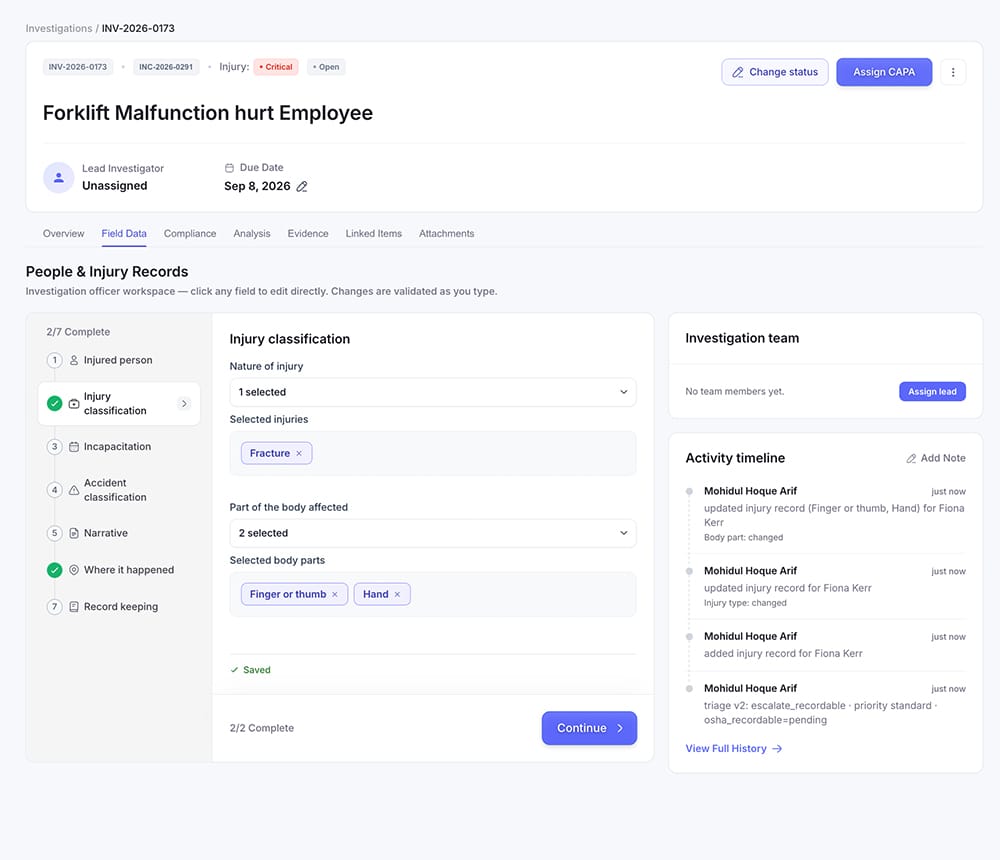
An investigation opened the same day, with its lead assigned
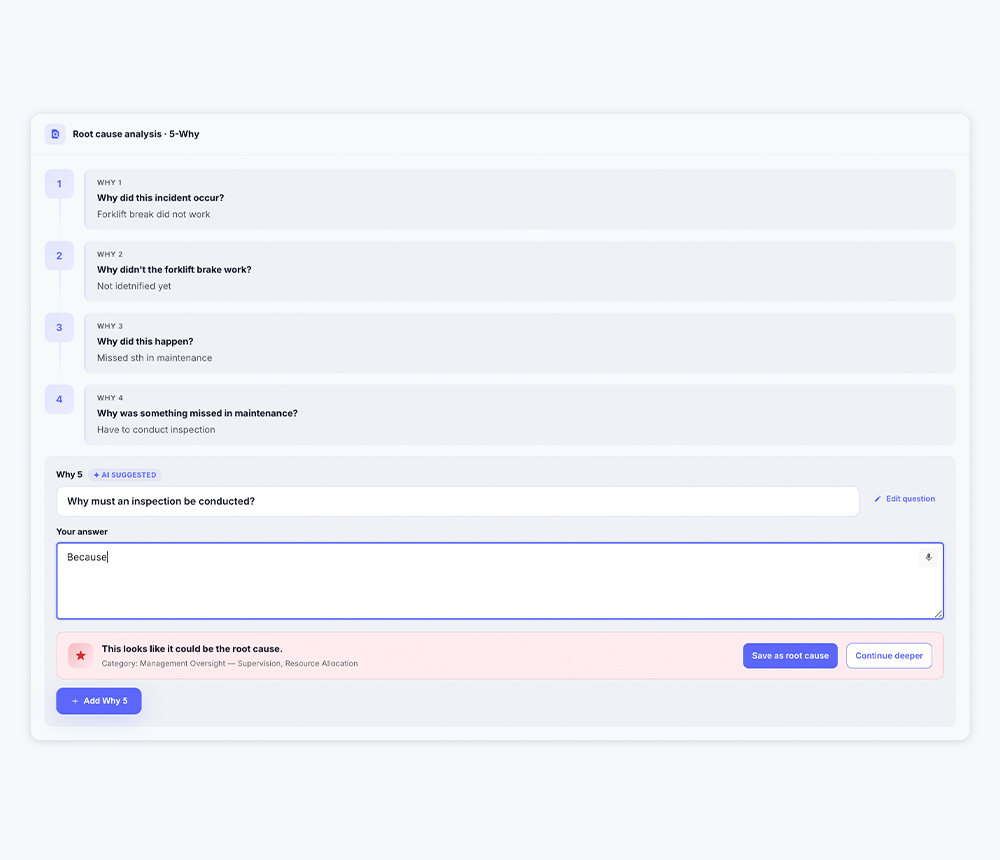
2 · Root cause analysis

Get a real cause from someone who has never done this before

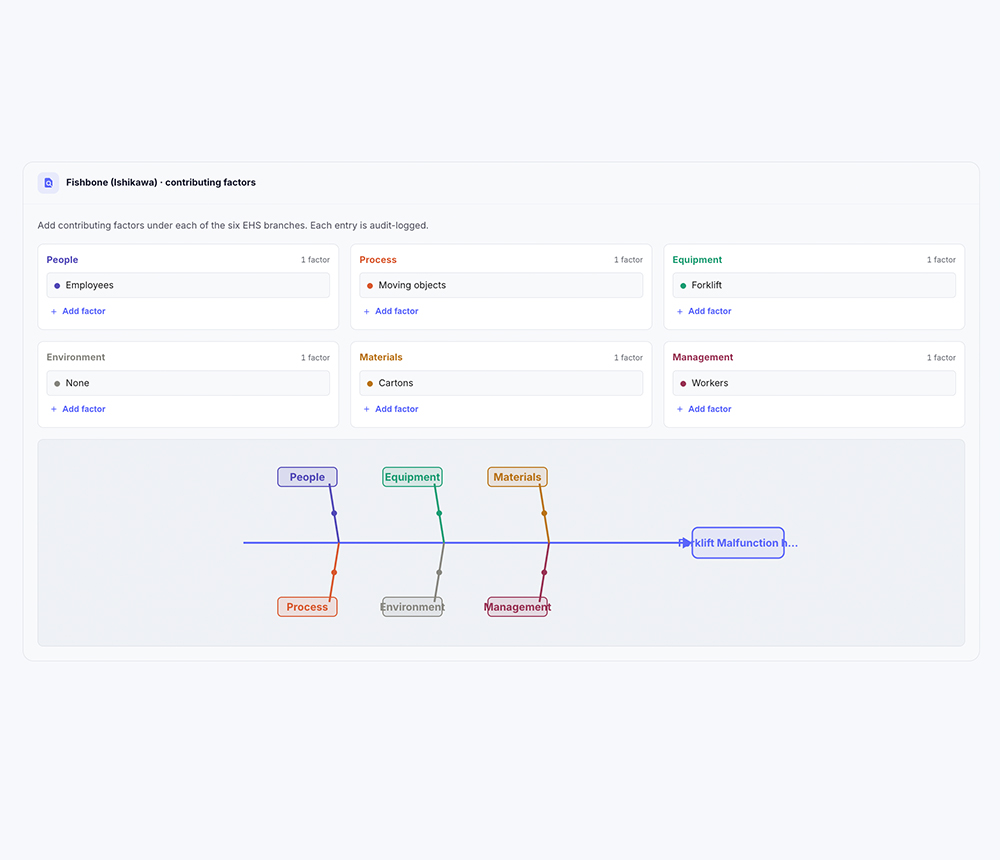
Each answer becomes the next question, and the system proposes what to ask based on what was just said.

  • One root cause, tagged Flagging a new root cause clears the old one, and every cause carries a category.
  • Fishbone and decision tree for the messier ones Six branches when the cause isn't a single chain, or a tree for sequential choices.
  • Standards cited against findings CFR, ISO, ANSI, NFPA or your own procedure, attached directly to the conclusion reached.

What that gets you. A supervisor's first investigation reaches the procedure behind the behaviour, instead of stopping at “the operator made a mistake.”

Guided root cause analysis, with the cause tagged to a category
2 · Analysis · evidence

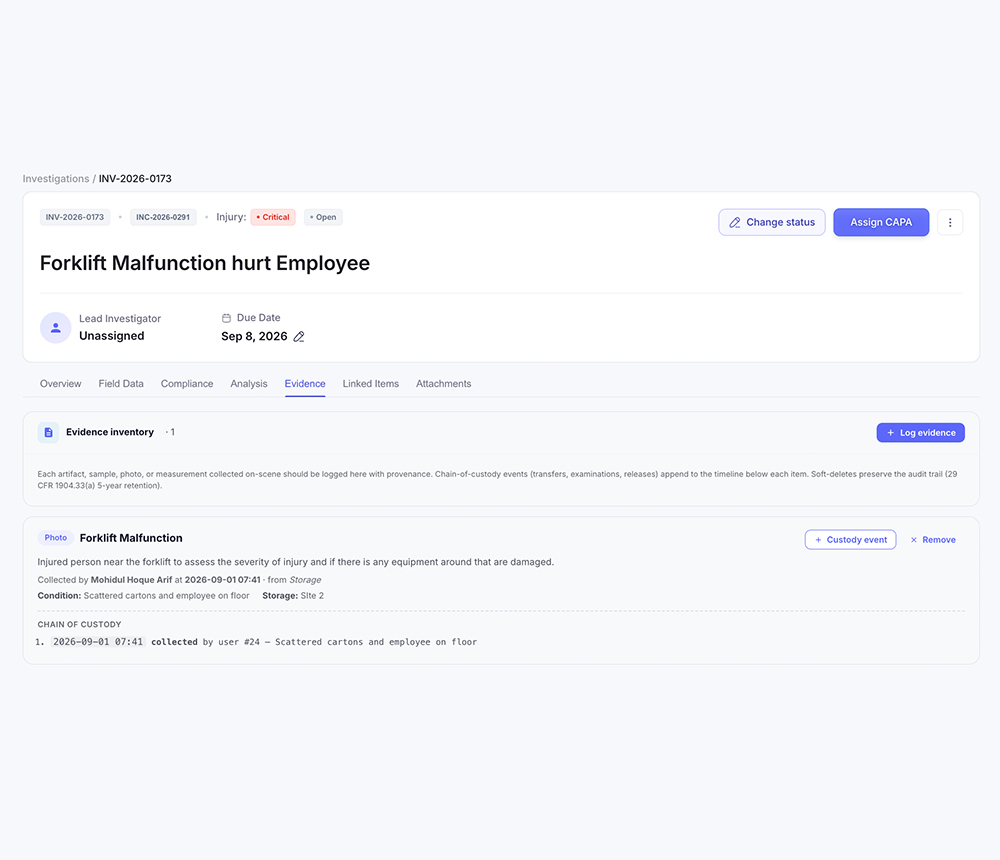
Show where the evidence has been, if you are ever asked

Photos are easy. A part that leaves the site for supplier analysis is where most systems hand you back a spreadsheet.

  • Every handover recorded Collected, transferred, examined and released, each with a named person and a system-set time.
  • Named collector, always Attributed to a real account with a real person behind it, never a typed name.
  • An append-only audit trail Entries can be added but never rewritten, so the record an auditor reads is original.

What that gets you. If the finding is ever challenged, you can show where the part was every day since it left the machine.

Evidence attached to the analysis, with each handover recorded
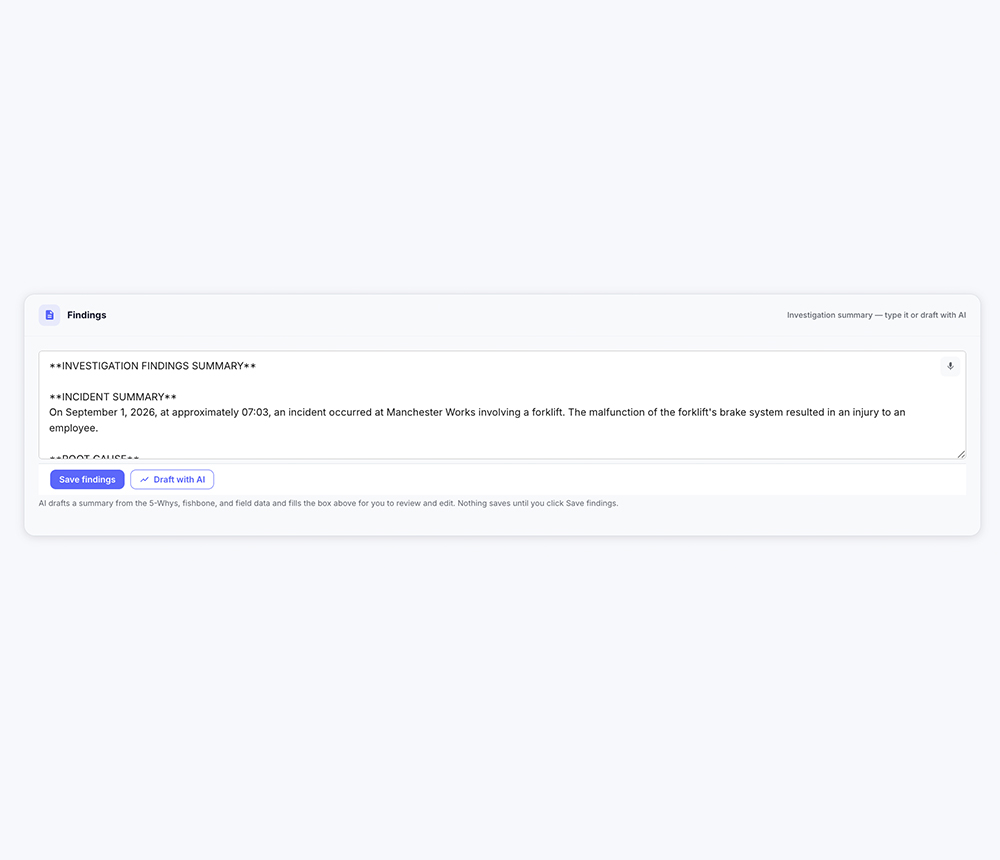
3 · Findings

Write the report without losing an afternoon to it

AI assembles a draft from what's already in the case. You edit it and save it — or throw it away.

  • Nothing saved until you say so The draft sits outside the record until a person reads it and accepts it.
  • No names in the narrative Injuries and body parts are recorded, never individuals, which is what statutory forms require.
  • No invented detail Sections with no evidence behind them are left out rather than filled in speculatively.

What that gets you. The write-up stops being the thing that sits unfinished for three weeks because nobody wants to start it.

The findings, with standards cited against each one
4 · Review & closure

Find the gap now, not in two years

Your own closure requirements, checked as you go — so a gap surfaces while the facts are fresh, not two years later.

  • Independent review, if that's your rule Most processes want a second pair of eyes. Yours decides which roles qualify to review.
  • Gaps listed, not guessed at You see exactly which fields a statutory form still needs before it can be filed.
  • “Not available” is a valid answer Mark a field unavailable with a reason, so the gap is recorded rather than blank.

You decide what counts as complete. These are your requirements, not ours. The system holds whatever line you draw, and tells you when you're near it.

Review and closure, with the gaps a statutory form still needs listed
Why it matters

What changes for your team

The same six things every safety lead says are hardest about investigations.

Anyone can run one properly

Guided analysis means the quality of an investigation stops depending on who happened to pick it up.

Causes get found, not blamed

Working past the operator's decision to the procedure behind it is the difference between a fix and a retraining note.

Repeat problems become visible

Tagged causes mean the same issue at three sites reads as one pattern instead of three write-ups.

Nothing sits unfinished

The draft removes the blank page, which is where most investigations stall.

It holds up when challenged

Chain of custody, cited standards and a full audit trail, so the record can't be rewritten after the fact.

Something actually gets fixed

Actions come out of the cause with owners and dates, linked back to why they exist.

Bring us one you've investigated

Walk us through a real case and we'll show you how it would run under your own rules.

Book a walkthrough

In practice

Workers reviewing safety records together on site
“An investigation used to be a blank page at the end of a long day. Now it asks me the next question as I go and drafts the findings from the answers. I edit it, and nothing is filed until I say so. For one person covering fifteen hundred employees that is the whole difference.”
Rui FariaSetúbal Química · Chemicals, Portugal
One system

Investigations are one part of the platform

A cause raises the actions that fix it, updates the risk it relates to, and fills the statutory form it belongs on, on one site structure, one permission model and one history.

Incident ManagementReport injuries, near-misses and hazards from any device, then triage and classify them.CAPA ManagementOwners, due dates and independent sign-off, linked back to the finding that raised them.Risk ManagementIdentify hazards, score risk on your own matrix and track the controls that reduce it.Contractor ManagementApproval before they start, documents that carry their expiry, and every company on one register.Audit & InspectionMobile checklists, recurring schedules and consistent scoring across every site.Safety TrainingAssignment by role and site, with certification expiry surfaced before it lapses.Compliance ReportingOSHA 300, 300-A and 301, RIDDOR and WHS output produced from the records you already hold.
Assets & MaintenanceEquipment register with preventive maintenance and calibration schedules and pass or fail outcomes.
Document ControlVersioned policies and certificates with expiry tracking and full change history.
What it costs

The software is the invoice

Legacy vendors quote a license, then bill the setup, the migration, the training days and every change afterwards. It's a relic of an era when software took a year to install.

You pay for the software, not the consultants.

Priced on headcount, however many sites you run. Under 200 people, start a free trial and go. Above that, ask us for a number and you'll get one.

On your invoice
  • The software
  • Every module
  • Your headcount
  • Setup of your rules
  • Reports built for you
  • Changes, whenever
  • Support
Never on your invoice
  • Implementation fee
  • Configuration project
  • Consulting hour blocks
  • Change requests
  • Professional services minimum
  • Data extraction on exit
  • No implementation fee
  • No professional services minimum
  • No hours to buy for changes
FAQ

Frequently asked questions

Still have questions? Our safety experts will answer them against your own process rather than generically.

Talk to our safety experts
Incident investigation software takes a case that warrants investigating, guides the analysis that finds why it happened, holds the evidence behind that conclusion, and turns the cause into actions. In EHS Solutions by SDS Manager the investigation opens from triage with the whole record already attached, so nothing is gathered twice, and the actions it produces stay linked to the cause that created them.
The difference between a cause and a root cause is how far back you stop. A cause is what happened immediately before the harm, usually something a person did. A root cause is the organisational condition that made that action the reasonable choice at the time, which is almost always a procedure, a design or a pressure rather than a decision. An investigation that stops at the first answer produces a retraining note; one that reaches the root cause produces a fix.
Guided 5 Whys, fishbone (Ishikawa) across six branches, and decision tree, used singly or together and chosen per investigation, so a minor case doesn't get the treatment a serious one needs. Alongside them: evidence logging with chain of custody, regulatory and standards citations against findings, cause categorisation so repeat problems surface across sites, and AI-drafted findings you edit and approve. Which methods are available, and when each is expected, is part of your configuration.
No, your people don't need root cause analysis training to use it. The method is guided and the next question is proposed from the answer just given, so a supervisor running their first investigation follows the same sequence an experienced facilitator would.
AI writes a draft of the investigation report, not the report. Nothing enters the record until a person saves it, and the draft is assembled only from evidence already in the case rather than from anything invented. Sections without evidence are left out instead of filled in, and drafts never name individuals, because statutory narratives shouldn't.
Chain of custody is recorded as a sequence of handovers: collected, transferred, examined, released, each attributed to a real account rather than a typed name, with a system-set time. The log is append-only, so entries can be added but never rewritten. If a finding is challenged two years later, you can show where a physical sample was on any day since it left the machine.
If evidence genuinely can't be obtained, the field is marked unavailable with a reason — the physician was unreachable, the equipment was destroyed. The gap and its explanation both stay in the record, which is more defensible than a blank field or a guess.
Whether someone else has to sign off depends on your process, and most organisations want independent review. Where you require it, EHS Solutions by SDS Manager holds to it and records who reviewed what. Where you don't, it stays out of the way. Which roles qualify as a reviewer is part of your configuration.
Yes. Any incident type can be escalated to a full investigation, including near misses, and investigations can also be opened on their own — for an audit finding, a trend, or a concern somebody raised — then linked to an incident later if one turns out to be related. Investigating near misses is where root cause analysis is cheapest, because nobody has been hurt yet.
Yes. ISO 45001 clause 10.2 requires you to react to an incident, investigate it, evaluate the need for action to eliminate root causes, implement the action, review its effectiveness, and retain documented information on both the actions taken and the results. In EHS Solutions by SDS Manager the analysis, the evidence, the findings, the independent review and the actions raised from the cause are all held on the same record.
Chemical and SDS management connects directly, because EHS Solutions by SDS Manager is built by SDS Manager, whose core product is a chemical and safety data sheet compliance database. When an investigation involves a substance, the safety data sheet is attached to the case from that database, so whoever is analysing it has the hazard information in front of them rather than in another system. SDS Manager is part of the NetPower group, headquartered in Norway with offices in the United States, Vietnam and Bangladesh.
Setup takes days, and your team's part is describing how you investigate today. In EHS Solutions by SDS Manager your methods, review requirements, closure criteria and cause categories are configured before go-live, by our team. There's no implementation fee and no consulting hours to buy.

Bring us one you've investigated

Walk us through a real case and we'll show you how it would run under your own rules.
Book a walkthroughorStart free trial

SDS Manager AS

  • Safety Data Sheet management for users of chemicals, retailers, webshops and manufacturers

Solutions

  • SDS Manager - SDS Management, Compliance & Employee Access
  • DirectSDS - SDS Distribution for eCommerce and Distributors
  • ExactSDS - SDS Authoring, Creation & Translation

Free Tools & Services

  • Free SDS Search with Update Notifications
  • Free SDS Management Tool for Small Businesses
  • Free generator for Secondary Container Labels
  • Free Tool for Generating Transport Labels

Company

  • About Us
  • Partner Program
  • Contact Us

Address

Thunesvei 2, 0274 Oslo Norway

+44 20 3936 1240

Privacy PolicyTerms and ConditionsCertificationsService Fulfillment Policy
©2026 SDS Manager |All rights reserved